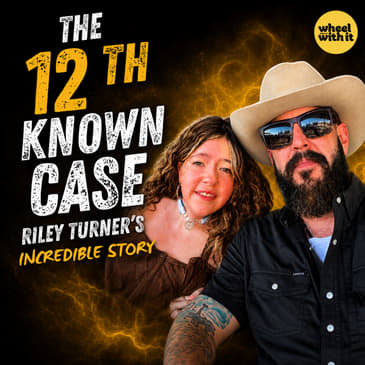
The 12th Known Case in the World | Josh and Riley Turner’s Incredible Story | Wheel with It Podcast
Riley Turner spent 12 years without a diagnosis before her family finally received an extraordinary answer: she was the 12th known case in the world with her rare genetic condition.
In this episode of the Wheel With It Podcast, Riley and her dad, Pastor Josh Turner, share her remarkable story—from doctors initially believing she had spinal muscular atrophy and telling her family she might only live a year, to eventually receiving her diagnosis and discovering her own voice.
Josh shares the emotional story of the first time Riley spoke after her family had been told her vocal cords weren't strong enough for her to speak. Today, Riley is pursuing a degree in ministry with the goal of becoming a preacher.
We also talk candidly about disability stereotypes, faith, Medicaid waivers, the challenges that forced Riley's family to move from Florida to Georgia, disability-related marriage and financial issues, and what needs to change within the Medicaid system.
Timestamps
00:00 Podcast Update
00:59 Meet Riley & Josh Turner
01:13 Riley’s Story & Calling to Ministry
02:07 Meet Pastor Josh Turner
03:05 Riley’s 12-Year Diagnosis Journey
04:13 The 12th Known Case in the World
05:29 Finding Meaning in the Number 12
05:52 The Craziest Thing an Able-Bodied Person Has Said to Riley
07:12 The Incredible Story of Riley Speaking for the First Time
09:21 “It Was a Full-On Miracle”
09:43 Riley Now Preaches
09:43 Coming to Terms With Riley’s Diagnosis
10:18 Losing Medicaid & Moving From Florida to Georgia
10:37 How a New Diagnosis Affected Riley’s Medicaid Waiver
11:25 Navigating Medicaid Waivers
11:39 Why the Turner Family Moved to Georgia
12:05 Disability, Welfare Reform & the Marriage Penalty
12:44 Being Told to Divorce on Paper
12:53 Faith, Family Values & Trusting God
13:46 The Most Annoying Disability Stereotype
15:11 What Needs to Change About Medicaid Waivers
15:53 Medicaid Fraud & the Nick Shirley Investigations
16:51 Hope for Medicaid Reform
16:59 Where to Follow Riley & Josh
17:53 Final Thoughts
18:06 Outro
Connect with Josh and Riley:https://joshbturner.com/https://www.instagram.com/joshuaturner/?hl=enhttps://www.instagram.com/_rileyturner8_?igsi=YmR0eDRqeHFobGFnhttps://www.10tenproject.com/
subscribe by going to wheelwithit.com/subscribe
[00:00:00] I will now be updating the YouTube and podcast feed every Sunday. Make sure you subscribe for free at either wheelwithit.com slash YouTube or getwheelwithit.com. If you would like updates on the podcast, my advocacy initiatives, and occasional reflections from me, subscribe to my Substack newsletter and have it delivered directly to your inbox at wheelwithit.com slash Substack. All Substack articles are written with AI unless otherwise noted.
[00:00:31] I love that I'm the 12th Known Case because 12 in the Bible means God's power and authority, and without that, I wouldn't be here today. So I love that. Well, this football-sized senior came up to me after worship sobbing and asked if he could hold me. I was like, no. I just drove off. Fun fact.
[00:00:59] Welcome to another episode of Wheel With It, and today we have two special guests. We have Josh and Riley Turners. We'll tell you guys how I heard about them. Tell us about yourself, and then we will get started. Hey, I'm Riley. Little about me, I just graduated high school. Praise the Lord. Don't have to do pre-calc anymore. Just the minimum amount of math required. I hated math. Same.
[00:01:25] But I had people who were in pre-calc, and pre-calc is not fun. No, it almost took me out. But yeah, so I am attending college online starting this August, which I'm really excited about. I'm going to get a degree in ministry, hopefully. That's the long-term goal of mine is to be a preacher and be in ministry because I feel like the Lord is giving me a unique story to share with people.
[00:01:52] And trying to pursue that as best I can. He certainly has. I think you're going to do very well with that based on what I've heard about you. So Josh, tell us about yourself, and then I'll tell how I found you guys. Yeah, my name's Josh Turner. I've been in ministry and a pastor for over 20 years. I now run a ministry called the 1010 Project, where I take pastors through a year-long journey of mental, emotional, and spiritual health.
[00:02:20] It's based off of 20 years of research with Biola University and Notre Dame. I travel and preach. I had a book come out last year on suffering called End of the Storm that my beautiful wife helped me write. But that's me. I do that. But my claim to fame is that I'm Riley's dad. The best claim to fame. I'm just in her entourage. Yes. Yes. I first heard about you guys through 1122. I am an offline 11.
[00:02:48] In addition to my local church, but I heard Joby, has Joby mentioned that you had a divorce, but for me, it's up like, oh, I'm on the way to that. And then I heard you on the Built for More podcast. I was like, I have that. So. I had to steal them from myself. Yes. Tell us what Riley's diagnosis journey was like and how crazy that was and the response and just her journey. Yeah.
[00:03:17] From my perspective, and then I'll let her tell you hers, is Riley was undiagnosed for 12 years. She's so saying. It was. Yeah. So they originally thought she had something called spinal muscular atrophy. They told us that she would live a year and then my wife and I would have to determine when to let her go. Obviously she's 18 right now. So that didn't really play out. We actually mapped out her entire genetic sequence. Everything kept coming back normal.
[00:03:44] There were obviously some physical disabilities that they were trying to figure out, physical issues going on, but really everything kept coming back normal. All the tests kept coming back normal. So for 12 years she was undiagnosed and then we were living in Orlando. I was pastoring a church and she was at Nemore's Children's Hospital and she had this one doctor that was studying this random kind of genetic abnormality. Right.
[00:04:14] And, and he said, Hey, I think this is what she has. If she has it, she would actually be the 12th known case in the world. And sure enough, she was, she got tested, came back. New genetic testing had come out in 2017. And so in, she got diagnosed for the first time as the 12th known case in the world. Which is crazy. And it doesn't even have a name. I think they name it after you or something because.
[00:04:41] I feel like it should be named after the first person, not the random 12th. The most prominent one, I would guess. So why not name it? Agreed. Agreed. Agreed. Yeah. It's really fascinating because it stems from the diagnosis periodic paralysis. But there's 12 people in the world who present exactly like me who have trachs and sleep on ventilators and are in wheelchairs.
[00:05:09] But there's a 60-year-old guy out there somewhere with it. So that's good news. But yeah, it's a really weird random diagnosis. My neurologist literally just swabbed the inside of my cheek. And then a month later, he was like, you're the 12th known case. I was like, oh, okay, cool. Thanks. Yeah. Corday at the office. Yep. I love that I'm the 12th known case because 12 in the Bible means God's power and authority. And without that, I wouldn't be here today. So I love that little fun fact.
[00:05:38] That is amazing. I was watching a message that you preached at SunYukub. I forgot where it was. And you said that. I was like, that is actually a great way to look at it. Thank you. So I love asking people this question. What is the craziest thing an able-bodied person has ever said to you? Oh, goodness gracious. Where do I begin? I think the best one that comes to mind is I was at a youth camp.
[00:06:06] And I think I was like 13 or 14. And I loved worship. Worshiping is my favorite thing. But some people respond to it weird just because they think I'm like in the middle of suffering. So like me worshiping is really powerful to them, which I'm like, it's very touching that people have that reaction. But this football-sized senior came up to me after worship sobbing and asked if he could hold me. I was like, no.
[00:06:36] I just drove off. Yeah, that's weird. People are like that. Yeah, I've had a lot of weird interactions. But that's by far the weirdest. That is crazy. I had this one guy just come up. And he had a limp. So I guess he was like holding onto it to keep from falling out. But I didn't know it. He was like, what ails you? And he was just holding onto it. And yeah, people just come up and they have no concept for personal space. No. Do people mean but don't know what to do with?
[00:07:06] Yeah, they mean but they don't really know what they're saying. Tell us about the first time why we talked. I was listening to the story. I was like, oh my gosh, you have to tell the story on the pod. Yeah. Yeah. So I was actually sitting and writing a sermon. And her mom was at Target. And they told us Riley would never be able to speak because her vocal cords weren't strong enough to vibrate.
[00:07:34] And so I was sitting there and I started hearing a noise. She was laying on the floor playing PlayStation with her older brother. And they were playing Disney Infinity, I remember. And I started hearing a noise. And I was looking around because I was like, what in the world is that noise I'm hearing? And she was covering her trach with her finger and sucking in and making a noise. And so I kind of watched her for a second.
[00:08:01] And I said, Riley, can you blow out and make a noise? And so she covered her trach and blew out and made a noise. And so I put my computer up, got on the floor with her, sat her up. And there's what's called a Passamere valve that you put on the end of a trach. So you can breathe in through the tracheostomy. But when you breathe out, it creates a seal. So it goes over your vocal cords. So I looked at her brother, Aiden, and I said, hey, can you go get her Passamere valve and put it on her? And I said, can you?
[00:08:29] And I got my phone out and recorded and said, can you say mommy? And she said, mommy, breathy and all that. But her vocal cords vibrated. So my son and I just lose it. We're sobbing, crying. Riley's looking at us like, why are you guys crying? And so. It's a Tuesday. Yeah. She's like, I've just been communicating like normal. And so we were all sitting on the couch. I call my wife and I'm like, hey, you need to come home. Riley's talking.
[00:08:58] And so I'm like, you need to come home now. And so she walks in. I'm sitting on the edge of the couch. Riley's in the middle. Aiden's on the other side. Me and Aiden are both crying. Becca walks in holding Target bags and Riley looks at her and says, hey, mommy. And everybody just loses it except for Riley. Cause Riley's like, I've been talking to y'all for eight years or whatever. And so it was like a, it was the full. I always say I don't have a problem believing God still does miracles.
[00:09:27] Sometimes I just have a problem believing he doesn't for us. And it was a full on miracle. She starts talking out and we never went back to sign language after that. No. He was like, well, why do we need sign language? I've been. For sure. Yes, ma'am. And now she preaches. Yeah. So what was it like when Riley was first diagnosed, especially like when you didn't know what was it like coming to terms with all that? If you don't mind talking about it.
[00:09:54] And yeah, it wasn't honestly, it didn't really change that much for us. There wasn't anything we really had to come to terms with in regards to Riley or to us. It didn't change anything really for us with her at all. If anything, it gave us answers a little bit more. And so there was maybe a little bit more around it for us. Now, what it did do is we lost all of our Medicaid in the state of Florida and we had to move to Georgia.
[00:10:22] And so that's why we've been in Atlanta now for eight years, seven years, something like that. I'm not good with numbers. And so that was the main thing that we. Oh, sorry. No, go ahead. Are you a Medicaid in the state of Florida? Cause she didn't have a diagnosis. No, we actually had Medicaid because they gave us a working diagnosis of spinal cerebral disability when they thought it was SMA. Then when she got diagnosed and we found that it was genetic, you get kicked out of that Medicaid
[00:10:50] waiver and you go to the back of the line at whatever the new disability is for the new diagnosis is, which was genetic. And so we ended up going to the back of the genetic line for the Medicaid waiver, which I think we were like 1500th on the list or something like that. I'm on Medicaid waiver too. I've never heard of that. Is that just supportive? Yeah. Different States handle their Medicaid differently. So that's why we moved to Georgia. Can I ask you on Medicaid waiver now?
[00:11:21] Yes. Medicaid waivers are crazy. What's been your experience like navigating the Medicaid waiver? Honestly, it's mostly been my wife. I would probably be the worst to talk to about that. She has been the soldier of that in our family. The reason we moved to Georgia is I think there's seven or eight States that have one waiver called the Katie Beckett way. Yeah. Virginia had that too. That's how I was able to get on it. That's why we moved to Georgia.
[00:11:53] So a lot of States don't have it. And so for us, it was, we had to find a state that had good hospitals and a state that had the Katie Beckett waiver and Atlanta was the place. And so that's where we ended up moving. So I am a welfare reform advocate, which trying to get the asset limits raised to qualify and eliminate the marriage penalty. Have you guys got our head of, okay, if Riley super high paying job or falls madly in love
[00:12:21] with somebody, are they going to get married? Are they going to live together and not be married? If Georgia has the caregiver exemption. Yeah. Riley would definitely not live with anybody and not be married. I'm not saying that because I think it's like, no, I know. Good. I know. Sometimes the only way around the regulation. Yeah. They actually, when we had Riley, one of the advices that we got was for my wife and I to get a divorce on paper.
[00:12:51] Yes. I've heard of that. Here's the thing. At the end of the day, we're a Christian family. We believe in Jesus. We believe in God. I've been a pastor for over 20 years. There's enough money in the kingdom and there's enough money that God can do whatever God wants to do. And I'm not, and we as a family, we're not going to diminish our values and our calling to fall in line with what, what would work for the government, so to speak.
[00:13:18] And for us with Riley, we've, we have special needs trusts. We have all that sort of, and so there's smart ways around stuff and you do the thing that you do is you do all you can and you leave the rest in God's hands. I was just wondering for you personally, cause that's something I've wrestled with. I was always a Christian, but now I want to do it out of because those are my values and not just checking a box. Oh, I'm a Christian now, but that's something I've wrestled with too is okay. What do I do?
[00:13:45] What's the most annoying stereotype about disability? It's all disabled people are the same and are treated the same. I had the opportunity to be a part of a camp over the summer. I got to be a counselor and it was like the funnest week. But one of the things that they always say is when you meet one person with a disability, you have met one person with a disability.
[00:14:09] So I should not be treated the same as a person who is experiencing autism or Down syndrome, just like how they shouldn't be treated like a person in a wheelchair. Yeah. We are all individual people. And so we all deserve a level of respect to not be like all locked together in one category. So, yeah.
[00:14:35] I hate it when people are sending me, well, my cousin with this same, I'm like, it's different. Even if you have the same disability, like everybody's different kind of thing. Yes. Yeah. I've had that happen too. My brother had crutches for a month. He broke his leg. Not the same. Not the same. Like when my, and this is the closest I'll give them this, but when my dad had his knee replaced, I'm like, that is not the same at all. No, that's funny.
[00:15:04] Anything you want to add before we get off here? Not that I can think of, no ma'am. And what is one thing which would be changed about Medicaid waivers? You know that world more than I do. Yeah. I just, I think if I could, we could change one thing with Medicaid waivers is that it's easier to get for the people that really need them. Oh my gosh. Yes. Like you jump through a million different hoops and it's, it's just ridiculous for the families that really need them.
[00:15:34] And then they say that they have these services, but they don't have them in practice because the provider rate is so low that nobody wants to do it for that little pay, but we can't offer. But we just don't have the provider rate to offer it because nobody wants to do it for that little pay. And then I don't know if you guys have seen the Nick Shirley video. Oh my gosh. Go watch those. I have a whole playlist on my channel where I react to them.
[00:16:03] It's these Medicaid fraudsters that are like, because you can have certain, certain businesses that receive Medicaid funding, like home health, like have like physical occupational therapists and sometimes personal care aides come to your house. And like, so they're basically like building all these businesses and just pocketing the money that they get from Medicaid funding. And they're making a million something dollars a day. Oh yeah. It's crazy.
[00:16:31] And like, it's in my opinion, it's like blatant refrigerant because nobody can tell you how to go into the daycare, like adult daycare, for example. Nobody wants to show you the facility. It's just, it's crazy. It's just. Yeah. It's really crazy. The Medicaid world is crazy. Yeah. So hopefully we'll get some reforms in the next few years because it's starting to get some traction. For sure. But, so thank you guys for being here. Where can people follow you on social media?
[00:17:02] I think my thing is underscore Riley Turner eight underscore. Yeah. I made it when I was like 12. I don't know why it's still. It's just Joshua Turner. Yes. And not to be confused with the country music artist Josh Turner, because I tell you. No. Josh Turner. And I'm like, oh, yeah. I got to tell you. Yeah. He's. Pastor Josh Turner. Because. Yeah. He's doing a lot better in life than me. That's. That was funny.
[00:17:30] That cracked me up when I first typed it in because I was like. Boy guys heard that all his life. All my life. I'm a constant disappointment in Nashville when I show up the reservations. Oh, yes. Has that ever happened where people thought that you were going to be like. Oh, yeah. Be Josh Turner. Yeah. Yeah. Yeah. Definitely at reservations when we're in Tennessee and stuff. For sure. That's funny. That's so. Thank you guys so much for being here. Follow us. Yes, ma'am. At we go with it dot com slash followers.
[00:17:59] We'll put the links in the show notes and we will see you guys next episode. Bye guys. Bye. Thank you for joining us. If you're listening on Spotify or your Facebook podcast app, please be sure to hit the follow button and if available the bell to get notified when we upload new episodes. It really helps support the show. Also, if you're on Spotify, please leave us a comment. If your podcast app allows you to, please rate and view us. It helps more people find the show.
[00:18:30] Remember to follow the show and our guests on social media using the links in the show notes. We'll see you next time.