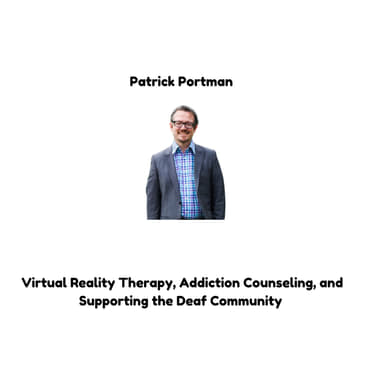
A conversation with therapist Patrick Portman discussing therapy techniques, addiction counseling, virtual reality therapy, and insights into the deaf community. Host Devon delves into overcoming obstacles and interactive strategies for communicating with deaf individuals.
00:00 Introduction to Patrick Portman
01:33 Life Tools and Overcoming Life's Obstacles
02:08 Virtual Modules and VR Therapy
03:30 Addiction Counseling and Specialties
04:41 Virtual Reality Therapy with Oculus
06:13 Challenges of Children Born into Addiction
08:00 Brain Repair and Growth
09:09 Addiction Treatments Beyond Medication
12:09 Understanding the Deaf Community
12:53 Interacting with Deaf Individuals
Connect with Patrick:
https://www.facebook.com/pportman
https://twitter.com/lifetools0
https://www.linkedin.com/in/patrickportman
https://www.instagram.com/portmanpatrick
https://www.youtube.com/c/PatrickPortman
lifetools.online Connect with Devon/the show:
https://linktr.ee/wheelwithitpod
subscribe by going to wheelwithit.com/subscribe
[00:00:00] Welcome to the Wheel With It podcast with your host Devon. At Wheel With It, we are dedicated to exploring DEI issues in a fair, balanced and fun way. Let's get into the episode.
[00:00:10] Hello, hello! Welcome to another episode of Wheel With It. On today's show, we have Patrick Portman. He is a fascinating guy. He's a therapist that uses all kinds of cool therapy techniques
[00:00:23] that we'll talk about in the show. And he has a wife who is deaf and he is hearing. So he has a lot of really cool things to say about that. I love this conversation with him. Sorry, this episode
[00:00:39] is a day wait with Momore Day and everything. And it was my favorite weekend of the year, which was the Indie 500. So I take time and watch that. So that is why this episode is coming
[00:00:52] out Tuesday. And speaking of, I might have a very cool surprise for you guys in regards to that coming soon. I don't know exactly when, but I am bouncing out the walls to hope we get to share
[00:01:04] life with you guys. With that in mind, here's my conversation with Patrick Portman. Welcome to Wheel With It, Patrick. Thanks for having me. First of all, to us by yourself. And then we will get started. Sure. Again, my name is Patrick. I am married. I have five children
[00:01:28] and live in Cincinnati, Ohio. I'm currently the executive director of a company called LifeTools. And we provide training and resources designed to help people overcome some of life's biggest obstacles. So what are those obstacles that you help people? I like to always say each person's
[00:01:46] journey is different. There's no instruction book in life. And so our organization attempts to try to tackle some of those issues, whether it be relational issues, whether it be mental health issues, just different challenges in life when it comes to parenting, when it comes to
[00:02:06] different challenges that people face. And we create online and virtual resources designed to help them overcome whatever challenges in their road. Yeah, I was listening to a podcast that you were on to prepare for this. And those virtual modules are really cool. Can you tell us about
[00:02:24] what the virtual modules entail? Sure. We use Canvas as our platform to broadcast. It's a similar platform that a lot of colleges and universities use. Yep. And so although you don't get college credit for these courses, there are really little small snippets that
[00:02:41] you can go through, maybe a five to 15 minute module each day to help you assess and overcome certain aspects. So again, maybe you're trying to do a module in overcoming depression or maybe you're struggling when it comes to relational intimacy, when it comes to relationship and
[00:03:01] would like to go through a course with that, maybe you're battling an addiction and want to have steps on how to overcome an addiction. So each module, each course breaks it down into
[00:03:12] smaller modules. And again, you can go at the pace that you want. You can access them from really any computer tablet, even your cell phone or any other device that's connected to the internet.
[00:03:23] So it's able no matter how busy your schedule is, you can do it on your lunch break at work or even in the evening or whenever you have free time to go through each of those courses. So can you tell us a little bit about your addiction counseling?
[00:03:39] Sure. So I adopted three of my five children and all three of them were born into addiction. So I wanted to learn how do I parent children that were born into addiction. I went to
[00:03:51] Liberty University to study counseling as well as to focus on addiction. I am an addiction specialist and focus or have specialties in alcohol addiction, substance addiction, gambling addiction, sex addiction. I also attended Harvard and majored in neuropsychology to look at the
[00:04:11] neurological components to conditions, particularly addiction so that I'm able to help people that may be a traditional therapy is not working for. So our practice specializes in some different forms such as VR therapy which uses inoculus. We also specialize in light therapy,
[00:04:32] kinesthetic therapy, so different treatment modalities to help individuals that again may be used a different practice and it wasn't successful. So they want to try something different. Can you tell us about the virtual reality therapy for a minute?
[00:04:49] So virtual reality uses inoculus. This is a meta two which a lot of people maybe are familiar with in the gaming world to utilize maybe their virtual reality games that they play on there. These have special software loaded on for the mental health world to help with
[00:05:07] different conditions. Addiction as we just mentioned depression, PTSD, anxiety. So it allows me as a therapist to have a controlled environment and walk a patient through a specific scenario to overcome that particular condition. I'm able to control what is sent to the oculus
[00:05:29] through a computer and be able to see real time what the client is experiencing, whether it be a medical issue of their blood pressure rising to maybe fear kicking in to maybe a specific
[00:05:44] trigger. And so the oculus creates like I said a virtual reality environment for me to be able to see what's going on in real time. So that is so cool. I had never heard of virtual
[00:05:57] reality therapy until I was listening to the podcast that you want to prepare and I was like that is so cool. You mentioned that you had children that were born addicted which I'm sorry that your kids have to go through that but what are some of the challenges
[00:06:17] of children born into addiction? I think one of the biggest things is the developmental piece. I think when a child is born and oftentimes they look kind of percent normal. When a mother
[00:06:31] who is battling addiction gives birth, they look at the child and I think they're expecting to see a physical normality and when they're not they're like oh okay perfect. My child is normal
[00:06:44] and there was no damage to what I did but oftentimes the addiction often hits the child in the neurological compartment and particular in the form of development. So you see this later in
[00:06:59] life most frequently you see it in the form of learning so maybe a stronger case of ADHD, maybe there's some form of learning impediment, some children we see autistic qualities with that. So each child is impacted differently but they all exhibit symptoms typically in the learning
[00:07:20] and auditory or visual departments and that's one of the reasons why I went to study the neurological component because the brain is repairable. If there are deficiencies you can work
[00:07:31] with any child with ADHD or PTSD or any of those conditions and be able to help them get caught up. All of my children have made significant progress in those areas and some of the conditions
[00:07:44] that they suffered with earlier in life they've since passed so my oldest child for instance has struggled with reading early on and now he reads a chapter book a day he's one of my speed
[00:07:55] readers so it just shows you with therapy any of those conditions have solutions and children can out outgrow those conditions. I answered it before but how can our brains be fixed? Okay your
[00:08:10] brain is constantly repairing itself so we used to have the mindset that your brain developed from conception all the way to age 26 with modern technology we have found that the brain continues
[00:08:26] to develop and grow and repair itself even past age 26 the only challenge that we have is after 26 the process to which the brain repairs or grows slows down and so with certain technology such as
[00:08:43] light therapy or VR therapy you can tell the brain of the brain you want to work on can send the energy to that particular part of the brain and thus repair it or modify what we call
[00:08:58] bad synapses is between what the brain think of it recorded before so you can fix those connections so those kinks or quirks or bad data can be fixed over time. So what other addiction treatments are there besides medication? Okay medication assistance is one of the most prevalent
[00:09:20] forms of treatment out there medication different types of medication being used such as vivitrol or suboxone of the top two that are used those help an individual to not go into relapse and will relapse symptoms. The challenge with medication assistance is sometimes people
[00:09:40] will get on medication and they think oh look I'm cured I'm not having any cravings anymore I'm not going through withdrawal symptoms but the reality is they're still on those medications and the challenge with any drug is over time you can that drug can lose its effectiveness
[00:09:58] for instance if you took Tylenol every day over time Tylenol is going to lose its effectiveness and it's not going to be able to treat pain and it's the same with any other drug. So in addition to what we call medication assistance therapy those are usually combined
[00:10:15] with individual counseling for an individual to work with a therapist to look at what's the underlining issues underneath the soil of addiction what are the needs that are being fused into addiction what are is there wounds what are their developmental pieces what is
[00:10:33] the damage caused so there's multiple underlining issues that can be addressed with a professional therapist in a form of individual counseling. There's also group counseling studies have shown that group therapy can be effective for addiction first of all to be in a room with other people
[00:10:50] that understand what you're going through sometimes family members of those battling addiction don't understand it they're just like we just stop thinking that way we stop taking those drugs most family members they don't understand it think it's 100 behavioral which
[00:11:05] is not there's a chemical dependency and there's where the neurological component can come in. So group therapy can be very helpful to work as a group to hold each other accountable and to tackle some of the issues in a community environment that can help an
[00:11:23] individual to progress in addition to that we mentioned earlier about VR therapy the r therapy again helps to look at different components that you can't in a traditional counseling session or in a group session on top of that there's light therapy there's
[00:11:39] kinesthetic therapy which is touch which in a lot of cases can be effective there's hundreds of different forms of therapy out there and the goal is to find a tool if you will
[00:11:53] a form of therapy that that fits that person's needs because with addiction one size is not fit all so sometimes you just need to change it up and see what works for that client and then
[00:12:05] move move forward with that one of the things that really do me to you and made me want you to have made me want to have you as a guest is your wife is that that's true so I am passionate
[00:12:19] about helping people understand the deaf community many in the deaf community will not go and see a therapist because they don't speak their language and many in the deaf community will not go seek treatment so I'm passionate of helping others understand the deaf community understand the
[00:12:38] needs of the deaf community I'm fluent in American Sign Language those clients that are deaf can sign up for consultation and have a therapist who can speak their language and feel safe that their
[00:12:51] needs are being addressed that's really cool so if somebody doesn't know sign language how can they interact with somebody who's very good question there's lots of technology out there to assess with that so there's free apps out there that will translate and you see all the time people
[00:13:09] using google translator to translate english into spanish or so there is apps out there there's a phone system called purple most deaf people have an additional phone number that you can call them on
[00:13:24] and an interpreter will answer the phone and translate for them there's again apps out there that you can download on your phone to translate you can text someone you can write things out I
[00:13:37] think one of the biggest turnoffs that people in the deaf community experience is just people ignoring them I think people get freaked out that oh this person's deaf I don't know how to communicate
[00:13:48] with them so I'm just going to ignore them and they just want to be treated normal like any human being and so it's really no different than someone speaking Spanish or a different language
[00:13:58] you just find ways of communicating with them hola como está and it's the same with sign language you can learn sign language you can write you can some deaf individuals can read lips
[00:14:10] talking louder does not change anything so I see yes please so moving or talk loud and deaf means deaf doesn't matter how loud you speak they're still not going to hear you between being
[00:14:23] deaf and being hard of hearing and so I find that amusing that they think that if they shout louder than the person's going to hear them and clearly there's some ignorance in our society of what deaf means particularly in the airline industry when we don't provide interpreters but
[00:14:40] we'll show up at the gate with a wheelchair and it's there's nothing wrong with their legs their legs work perfectly fine and it's just their ears that are not working but lots of different ways of communicating with a deaf person but people assume that
[00:14:54] the deaf population is small but it's not we have 32 million Americans that are either hard of hearing or deaf and the reality is people are not all born deaf my wife was not born deaf
[00:15:06] she was born hearing but people do lose their hearing over time and so that's why it's important for people to learn American sign language because you may not know that maybe later in life you might learn lose your hearing or know someone that does
[00:15:19] and if you already know ASL then you have another language to use and to communicate with the world what are some apps out there that can translate English into AS? There's tons out there out
[00:15:31] there both on the Apple platform and the Android platform some different programs also have a built in feature to allow you to just click to add closed captions so if you're a broadcaster and using Zoom or using YouTube there's an automatic feature in there to add closed caption
[00:15:55] and that's very helpful for the deaf community and some of those apps also have another button that you can click to add sell or interpretation on there it's not perfect but it does add that
[00:16:08] I hire an interpreter for all of the media that we do so we offer all of our training courses in English as well as ASL so that someone who is deaf can take the courses in ASL and that just
[00:16:25] uses an interpreter so in the corner they just see the interpreter signing the entire broadcast I think there's confusion of what ASL is we think ASL is just a language but it's not
[00:16:37] imagine watching a movie with the sound completely off how much of that movie would you miss when you miss the sound of we ask someone how are you doing today and they say great
[00:16:50] is great good is great bad there's a lot that we miss is someone telling a joke is someone being serious so text alone is not sufficient in order for us to understand communication so ASL not only combines the language but it communicates feeling it communicates whether someone's
[00:17:11] telling a joke or not whether someone's serious there's so much that's built in there that we miss by just having closed captions instead of hiring an interpreter out there when it comes to
[00:17:24] like medical and mental health a lot of insurances will bill for interpreters so there's really no excuse why businesses particularly in the medical mental health world can't hire an interpreter for the deaf community because there's no out-of-pocket costs for them they can just
[00:17:44] build that to insurances in addition to that again there's apps that you can download on tablets and other things so that if you're a business owner if someone walks into your business you
[00:17:56] can click on the app and it'll provide an interpreter for you so what is some of your favorite apps again I'd rather not list particular apps out there because I don't want to plug
[00:18:07] one or the other I'll just just for copyright purposes and such I would just say there's tons out there that you can look for but if someone is struggling and like to know a particular app
[00:18:20] they can email me at PatrickAtLifeTools.org and I'll help them find an app that's conducive to their business world or to their lifestyle and go from there off the air yeah I understand
[00:18:33] that I just wondered if there was one you recommended but I will look up apps on the app store what are some of the challenges of you being hearing in your life being deaf?
[00:18:43] That's a good question I think some of the challenges is in the form of communication particularly when you want to express your emotion or feeling typically when we're upset we'll talk faster right and we may use vocabulary that we don't use in a given setting
[00:19:01] and so sometimes when a hearing person is communicating with someone in the deaf world there's words or things that are out of context that both parties don't understand so for instance
[00:19:15] if you and I went to a restaurant and we're sitting at a booth in the hearing world it's taboo to listen to other conversations right we just tune out those conversations in the deaf world
[00:19:28] they like to know everything that's going on in the world and there is nothing that's off limits to them as far as listen to conversation if someone wants a private conversation they're gonna pull into a different room so there's different cultural things that were
[00:19:44] different I didn't start off knowing ASL when I first met my wife I knew very little and so I had to hire a tutor to help me pick up over time I'm still learning new words every day and so again
[00:19:59] the amount of language that you understand impacts the relationship that you're gonna have in any relationship it's an investment to invest into that person to communicate with them and if you don't know that language is it creates a barrier for that person to open up
[00:20:17] and share with you and for you to share with them that's really insightful so deaf people will just basically pick up on every conversation they'll just scan again I say their ears don't work but
[00:20:31] their other senses are very in tune so my wife can see a fly on a wall like she's very in tune on top of that they're in tune to motion so they're in tune to that person maybe is a
[00:20:43] shady person or that person is sad so they tune into people's emotions so they have a greater ability to understand what's going on in a room without even hearing a conversation they study body language they study facial expressions they study movement to understand what's going on
[00:21:05] and can pick up more than you and I as a hearing person could ever pick up just by what they're not experiencing I always say my wife is lucky because she doesn't get to hear snoring
[00:21:17] she doesn't get to hear the kids fighting she doesn't yell nails down a chalkboard or going to my kids game when they have the buzzer going off with annoying sounds so all those annoying
[00:21:28] sounds that you and I experience they don't get to experience so I think in some ways she gets to sleep better at night because she's not distracted by the overall noises she can just
[00:21:42] tune it all out close her eyes and go to bed yeah I wish I could do that is there anything else that you want to add before I get off here I'm just encouraged all of your listeners to look at their
[00:21:53] life and what's holding them back from achieving the life they want if you're not happy with your life what's getting in the way of that happiness and there are tools there are resources there are professionals out there that can help you overcome that and the definition of insanity
[00:22:10] is doing the same things over and over again and expecting a different result so do something different this year my dad says that all give yourself a goal give yourself something to move forward but if you're not moving forward then you're going to move backwards and just encourage
[00:22:25] you to challenge yourself this year to do something different to learn something to grow and to be a better version of yourself okay thank you for coming on you've been so great
[00:22:37] where can people follow you on social media and websites and all that okay my nickname on all social media is this papa patrick you can follow me on tiktok and instagram and all of the social
[00:22:51] media is under papa patrick if people have questions you can email me at patrickatlifetools.org and again all the resources that we talked about today are on life tools website which is life tools.org there's lots of great resources to help you on your own personal journey
[00:23:09] we will have all those links in the show notes and again thank you so much for coming on wasn't that just fascinating i thought that was so cool especially with the virtual reality
[00:23:18] therapy and some of the tips he gave about how to interact with deaf people i i i like that so please be sure to follow him and me on social media all those things will be in the show notes
[00:23:33] and we will see you guys next episode bye guys thank you for joining us we hope you enjoyed the show remember to follow the show and our guests on social media and subscribe to the show and your
[00:23:45] favorite podcast app using the links in the show notes please remember to rate and review us see you next time