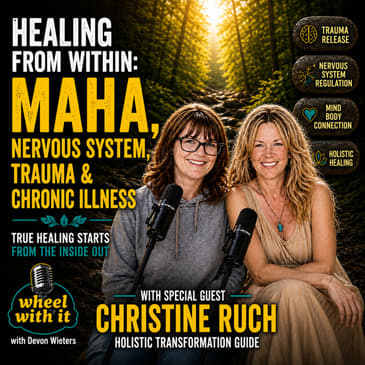
Healing From Within: Nervous System, Trauma, MAHA & Chronic Illness | Christine Ruch | Wheel With It PodcastIn this episode, Devin sits down with Christine Ruch, a holistic transformation guide who has spent decades learning how to heal from the inside out — starting with her own 20-year journey with a chronic health condition.Christine breaks down why mainstream medicine often falls short for people with chronic illness, how unprocessed childhood trauma keeps the nervous system dysregulated, and why true healing is less about finding the right treatment and more about restoring alignment from within.They also discuss the difference between a coach and a guide, the MAHA movement, SNAP benefits and food access, and what people newly diagnosed with MS or other chronic conditions should know first.🔔 Subscribe so you never miss an episode!
The difference between a coach and a holistic guideHow belief systems affect your ability to healMAHA, RFK Jr., and the broken healthcare systemSNAP benefits, healthy food access, and Colorado's double-match programChristine's mentorship program and how it worksAdvice for people newly diagnosed with chronic illness🌐 Learn more about Christine: christineruch.com📖 Christine's Substack: christineruch.substack.com📩 Follow Wheel With It:🔗 wheelwithit.com/followus📰 wheelwithit.com/substackTimestamps:0:00 – Intro / Teaser0:29 – Welcome to Wheel With It0:34 – Meet Christine Ruch1:25 – How Christine became a holistic transformation guide2:29 – What is a holistic guide? (not a coach)5:14 – Trauma, the nervous system & chronic illness9:58 – Coach vs. guide: what's the difference?13:29 – The broken healthcare system14:50 – MAHA movement & RFK Jr.17:06 – SNAP benefits & healthy food access22:15 – Christine's mentorship program22:55 – Advice for the newly diagnosed23:42 – Where to find ChristineSubscribe for more inspiring conversations:https://wheelwithit.com/youtube to subscribe on YouTube. Hit the bell so that you get notified when we upload new episodes! You can go to getwheelwithit.com to subscribe on your favorite audio platform! If you subscribe on an audio platform and the app allows it, please be sure to leave a five-star rating and review. It really helps people find the show!Follow the podcast and Devon on social media at wheelwithit.com/followus
subscribe by going to wheelwithit.com/subscribe
[00:00:00] I've had MS for 20 years and have largely cured my not a coach. And I think that's an important distinction. Unwinding a lot of structures, a lot of it is bringing people into alignment through the nervous system. How do we not live with our nervous system like fully? Childhood trauma that's not seen, not processed, and hasn't moved through the body.
[00:00:28] Welcome to Wheel With It. I am your host Devon Wieters. Let's get into the episode. Hello, welcome to another episode of Wheel With It. And today we have Christine Ruch on the podcast today. I hope I pronounced your name correctly. You did great. How are you today, Christina? I'm really good. How are you? So tell us about yourself and then we'll go from there.
[00:00:51] My name is Christine and I am a holistic transformation guide. And I work with people who have health conditions that they would like to heal differently than the mainstream medical system or narrative or healing modalities provide. And I work with people to heal from inside and I work with people to affect authentic lasting healing in any of their health conditions that they struggle with.
[00:01:21] That's amazing. So how did you get into that? Being my own guinea pig. I've had MS for 20 years and have largely cured myself of that condition. But along the way, I also had a really sick childhood and a lot of trauma in my childhood. And I had so many different health conditions and I was so sick as a kid. And even through all of my adult years, I suffered with a lot of illnesses and confounding.
[00:01:50] Yeah, just confounding illnesses and could never get better from mainstream medical systems and even a lot of alternative care. Like it's all been amazing. And I've learned an incredible amount and they're all incredible healers. So I'm not suggesting otherwise, except to say that I've learned a lot about how healing is truly more of a mindset and a belief structure in our authentic ability to heal.
[00:02:18] And it also is a lot about healing from the inside out rather than the outside in. What exactly do you do to help people heal? I'm a guide. I'm not a coach. And I think that's an important distinction because I meet everybody where they are in their own health journey. And I meet them where they are at. And and then we explore different ways to heal.
[00:02:44] Primarily, though, I work with nervous system restoration and trauma release and bringing people into alignment. A lot of times I feel like we are not in alignment. We live in service of other things and we don't live in our truth. And we live in service of actually keeping our nervous system completely messed up all the time. And we don't even we don't even actually have a connection. We don't realize that.
[00:03:11] So a lot of it is unwinding a lot of belief structures. A lot of it is bringing people into alignment through the nervous system and releasing trauma and re reconfiguring how you relate to your emotions in the world. And strangely, just that alone puts the body in a state of deep healing. And it just your body wants to heal and your nervous system wants to be balanced.
[00:03:39] And when that happens, then suddenly your body knows exactly what to do. And so it'll the healing process starts to take on a life of its own. So how how do we not live with our nervous system like totally disfigured? I think probably the first is to just have awareness that you are. I think a lot of people don't even have an awareness that they're nervous.
[00:04:08] They might say they might have like things that they say, such as you're getting on my last nerve or you're really triggering me or things like that. But but they don't fully realize that they can own their nervous system and they can take control of how they regulate themselves and they can create a different relationship with their emotions.
[00:04:30] And they need to look at also the relationships that they have in their life and their relationships with work and balance and all kinds of different things to start to pay attention to the ways in which they keep their own nervous system dysregulated. I'm looking at your con match profile and you have a lot of great questions.
[00:04:55] One of them is what role does trauma or stress play in the worsening of immune conditions like MS? And I think I know what this is because I have my own personal story, but I think you have caused by that. But I have my own personal story behind it. Not as severe as yours, but yeah. Yeah, I think a lot of people don't fully appreciate how our nervous system keeps us safe. It keeps us safe from everything that's ever happened to us outside of us and inside of us.
[00:05:26] And also that our body holds everything that's ever happened to us in our entire life. It's held within our body and is also regulated by our nervous system. So a lot of times we create a relationship with based upon old stories of trauma from our childhood. And then those stories create a belief structure and then those belief structures create emotional. It's a whole thing that's all tied up together.
[00:05:52] And so I think that people don't fully recognize how childhood trauma that's not seen, not processed, and hasn't moved through the body actually holds your nervous system in imbalance and leads to restrictions and it leads to illness. I had a very idyllic childhood. I'm lucky to say I had a very idyllic childhood.
[00:06:17] Not that much trauma, but I did as an adult had something really hard happen to me to really hard things back to back. And then about a year after I really, I've been in and out of therapy since I was 16, like well before this happened. But after about a year after I got really serious in therapy and I was like, okay, I gotta do something about this because it's like ruining basically.
[00:06:45] I got a eight week bout with vertigo and I thought I would die because I've had a lot of symptoms before. I've never had vertigo and it was horrible. And luckily it ended up being minor, like vestibular, three weeks of physical therapy. It was out. But I've always wondered what's that caused by the dramatic thing that I experienced?
[00:07:13] Did that contribute to it? I want to turn it back around and say, I feel like your intuition knows way more than me. I think that we bypass our intuitive voices and I can say unequivocally. Yes, but I think what's more important is that you already knew that you already know at some deeper fundamental level that this terrible thing that happened to you was being held within your system.
[00:07:43] And, and therapy is one thing and therapy is an important part, but also therapy always just happens in the mind and feeling and trauma and those sort of traumatic events live in our body. And so sometimes while you can have all this, these therapies as you want, you're really only working from the mind level. And that doesn't actually access what's actually held within your body and looking to be released.
[00:08:13] And so I think that there's a really strong correlation between your vertigo and these traumatic events that happened to you. And they weren't super traumatic. They were a lot less traumatic than they could have been because I was living with parents all the time. And honestly, I didn't even think about that till like last week. I said, I was sitting there thinking, I wonder if there's a correlation about events.
[00:08:39] What I also would like to bring up too is this idea that there has to be some sort of gradation of severity of this experience in order for it to qualify. Because what is traumatic to one person is not traumatic to another and your body doesn't know the difference. So you don't necessarily have to be like, I didn't see somebody get murdered. And so I guess it's not that traumatic. It's all the same.
[00:09:05] If it's still held in your body and it wasn't fully processed emotionally, it's held in your body. And there's no sense of like gradations of that wasn't severe enough to count. That doesn't, it doesn't work like that when it comes to the nervous system and the things that we hold your nervous system doesn't. It doesn't work like that. So we, that's a mental thing, like that we assign this idea of it's not, wasn't severe enough, or I know somebody who had way worse than I did.
[00:09:34] And so then you discount it and you're like, Oh, I wasn't that bad. But clearly maybe your body or your nervous system feels differently. Yeah, maybe. And I'm not saying that's what it was, but I didn't do anything out of the ordinary. I just woke up one day and had vertigo for the next eight weeks. I was dying. What's the difference between a practitioner and a coach? Yeah.
[00:10:02] So a coach generally is looking for, they normally have a linear path towards improvement of whatever it is that they're coaching you through. And it is a finite period of time and it's a linear process. And there is an outcome and expected outcome. So you are going to sign up with this coach for their 30 day program. And then they're going to give you this structure and you're going to everybody is also going to go through the exact same structure.
[00:10:31] You and I both would join a program for, let's say this theoretical coach. And you and I could be different places in our life, different ages, different, a whole bunch of aspects of ourselves are completely different. But we're both going to do this program for 30 days and have the same outcome. And I would like to say that's not really how we change.
[00:10:55] And that somebody who's invested in transformation recognizes that we all start from a different place and we all have our own unique path. And that it's not something that is linear. It's more of something that's a spiral. And it's also not anything that can, I can't force upon you my outcome. It's got to be driven by your desire for change and it's your outcome.
[00:11:24] And it's whatever that looks like, whatever that looks like to you. And so that could look different for each of us. And, but it doesn't mean that we both don't come out like winning or having made improvements or whatever dialogue you want to put around that. But it's a little bit different because there's no expectations. It's just a matter of me holding space for your process to unfold at its own natural, at your pace.
[00:11:52] And so it's a little bit different. Hi, I'm Doug Katz, inventor of the Nulu kitchen knife. The Nulu is uniquely shaped to work in harmony with the human body, greatly reducing the strain on muscles and joints common with traditional knives. Not only is the Nulu ergonomic, it's incredibly versatile. This knife is the kitchen MVP. Visit us at NuluKnives.com.
[00:12:16] That's N-U-L-U Knives.com to see this extraordinary knife in action and understand why we say Nulu is the knife that adapts to you. Visit NuluKnives.com and enter code WHEELWITHIT-NULU at checkout. Before we get back to the conversation, make sure you're subscribed so you never miss an episode. On whatever podcast app you're listening on right now, just hit the subscribe or follow button.
[00:12:45] And if there's a bell icon, tap that too so you get notified when new episodes drop. You can also subscribe to my Substack newsletter for updates about important disability policy at both the state and federal levels. And deeper dives into the topics we talk about on the show at wheelwithit.com slash Substack. And if you want to follow both me and the podcast on social media, you can find all the links in one place at wheelwithit.com slash followers.
[00:13:13] Now, let's get back to the conversation. We were talking before and you said you wanted to touch on how the healthcare system basically is not very human friendly. What do you want to say about that? I just think we're in a time of big change in the world, obviously. And I think that we're seeing a number of systems. I like to look at things from a system wide level at the highest level.
[00:13:39] And I think that we are starting to see how a number of different systems are not really working. And I think our healthcare system is one of them. People are increasingly sicker and sicker. And there's not really any emphasis on curing things. There's not really an emphasis on figuring out what the imbalance is that made you sick to begin with. It's really all about a pharmaceutical intervention to place a bandaid on your symptoms.
[00:14:08] And then you're expected to be in this treatment for this for forever. And so they want to keep you on this pharmaceutical track for the rest of your life and make you believe that's the only way that you can manage your symptoms. And that there is no... Some people do need medication, but people are way out of medication. Oh yeah, yeah. And I'm not saying that this is across the board that there's no room for medications.
[00:14:34] But what I am saying that is across the board that there's not an environment of cultivating one's own sense of self-empowerment. Usually don't do politics on here, but I have to ask... What do you think of Maha? I think it's great, personally. I think that for... Is everything perfect? No. But do I think that he has a very difficult job? Yeah.
[00:15:05] Because do I believe that they... The most difficult job. The most difficult job. The most difficult job. And do I think that part of the thing that makes it so difficult is that our leaders of those organizations and those institutions never really put the health of the human person at the forefront. They put special interests and other things ahead of the health of people. Yeah.
[00:15:29] And so now we have to dig out from underneath a lot of these other things that are really bad for us. And so I think that he's like climbing a huge hill. Like, it's crazy. Yeah. So I'm huge. It's hugely in favor of the man. And the movement. We'll see. Now, is it hard? And will he achieve everything? And is he up against a lot of difficulties? No question. But I think, yeah, I'm super... I'm a super fan. So that's a good way.
[00:15:59] That's a good way to describe it. I'm a super fan of R.F.K. before. Yeah. Like, what do you think about the snap waivers that he's pushing? I love the movement too. Like, I'm going to give away a little bit of my part. I love the Maha movement too. But I feel, and this is a whole nother thing, to see exactly what I'm talking about, you can go to realwithit.com slash report. We're not going to get it.
[00:16:26] There are so many federal rules about what you can and can't do on these benefits. The state of Virginia is great at a state level, but the federal rules stop so bad. So there's already enough federal rules that we have to deal with. I don't appreciate people being lazy on what they can and can't buy with their snap, but I understand why they're doing it. Yeah.
[00:16:56] I'm afraid I don't know the details of that specific, that specific program. I know that's program, but I don't know what, what rules you're speaking of. But I guess it's basically he's trying to do like, you can't buy soda or sweets. Yeah. Yeah. I think that's pretty much across the board though. I know that in Colorado, even before he was in charge, that was always the case for snap benefits in the state of Colorado.
[00:17:23] Virginia, you still can't, can, and a lot of states you still can. But basically the asset limits are so low that if you get a wartime, you will come off of it, but still not have enough to like pay for what you need. Yeah.
[00:17:42] So I think so, in that respect, I think that you bring up a really important, really important concern is that the price of healthy food far outweighs the price of soda and junk food. And so if you're living on a limited budget and it's difficult for you to come by healthy food, which is a tragedy, even like one apple could be so expensive. It's so ridiculous. So for sure. And now I think that this is where sometimes the state comes in.
[00:18:10] So like in the state of Colorado, for example, yeah, you can't get sodas or you can't use junk food, but also you get twice the, you get two for one benefits for fruits and vegetables. So for every $1 in SNAP benefits, you get $2 in actual. So it's almost like it's doubled for then the state takes on that extra dollar amount. Does that make sense? So you get twice as much for buying fruits and vegetables, especially at the farmer's market.
[00:18:39] So if you go to the farmer's market and you buy your stuff with your SNAP benefits at the farmer's market, then you get twice, you get double what your allotted amount is. Does that make sense? So what do they do? They look at your transactions and then give you money back?
[00:18:59] I don't actually know the details because I'm not a recipient of that, but I definitely know it's a huge portion of the program is that they give you twice as much money. And I don't exactly know how it works on the accounting side or the, I don't know, but I know for sure. I think they give you twice. So cool. Yeah. I'm surprised that there are people out there that are disciplined enough to look through everybody's transactions, but hey.
[00:19:28] Yeah, I don't know how, I don't know how it works. Yeah. I don't know. I don't know how it works on the back end of things, but I know with complete confidence that you do get extra for fruits and vegetables in the state of Colorado. That is amazing. I'm going to have to have a Colorado SNAP expert and ask the food expert. Yes, do it. That is amazing.
[00:19:50] But also with a bunch of these cuts and things like that, that I don't know if that has shifted just because of Trump and a lot of his cuts and services and things. So that may have even shifted. It doesn't affect people with legitimate disabilities. It only affects the people that are most likely to abuse the better. Yeah. Gotcha. Okay. Go ahead. No. Yeah. I don't know enough.
[00:20:17] I don't know enough about it otherwise, except to say that I know for sure in the state of Colorado, currently they're facing a lot of shortages for because of the funding cuts and things like that. So I don't know if the benefits have changed in the last year or so insofar as the specifics of the twice getting twice as much, like I just said, they, that may have shifted, but I don't know. I'm not really in that world. Like I used to be.
[00:20:47] You like, honestly, like, I wonder if he's pretty, he's like, regardless of what you think of the man's politics, like he's pretty on top of everything. So it surprises me that he doesn't like because of that program. Maybe he's got other, maybe they got other issues I don't know about. But, like, I would at least, if I was president, I would at least fund that program. That's pretty cool.
[00:21:14] Yeah, and I don't know if that's just how, like I said, I wonder if that's the difference between the federal arm of it and then that money goes to the states and then states get to administer that. And then I wonder if it's in the budget, then they like double that for like fruits and vegetables for recipients. I don't know how that comes into once it gets funneled to the state level, how that translates into, into benefit for the individual.
[00:21:41] So basically, what happens is, I don't know exactly how Colorado is, I can see, but these programs are run on a mix of state and federal dollars. So the federal government will like subsidize the state budget for these programs. And it's a whole thing because states will write too much on the federal dollar and don't put like what they need to do with the state dollar because they know the federal government will throw them out. So it's great.
[00:22:11] Yeah. Yeah. It's a whole thing is a bureaucratic mess. And please tell us about your program, your mentoring program and what that's all about. Yeah. So I have a mentorship program and it's a number of months you can choose, which I have three different offerings. And, and so, yeah, we just spend three months, six months, or nine months together.
[00:22:34] And we do a deep dive into all the things that are causing you to be misaligned. And we start to create alignment and release limiting beliefs and restore the function of your nervous system and start to help you on your authentic healing path. And what is your advice for people that have just been diagnosed with chronic illness, like MS? It definitely is for sure a reckoning.
[00:23:03] And a lot of times by the time you get a diagnosis, you know, you're sick and you don't feel well. I think what I always suggest is from the very beginning is just to start to ask yourself, like how much you believe that it is within your power to live a more full life.
[00:23:21] And, and I think it really starts with your belief systems and your real belief, like how much of your life have you given away to this diagnosis and how much are you willing to shift so that you can live in the fullness of your life experience. That is amazing. Okay. Now, where can listeners keep up with you and find out more about you and all that stuff? Yeah, so you can go to my website, Christine Rook.com.
[00:23:50] And you can also follow me on Substack, where I write articles about the healing, the power of healing and all the different ways that we heal as humans. I'm on Substack too. So you can follow me there too. I don't write very many articles because I know people hate getting spammed with emails, but I don't have very many subscribers. So I shouldn't be worried about it, but I just don't like to spade people. Yeah, for sure. Yeah.
[00:24:18] All my resources on Substack are free. I don't feel like it's, I feel like it's important for everybody to have access to different opinions around the healing path and how humans actually do heal. So I don't, I, I've written for a number of years and I just only write occasionally, but there's plenty of content there for people to go on and explore. I have recipes and yeah, different articles about healing.
[00:24:46] So please go check that out. We will have all those links in the show notes and we will see you guys next episode. Bye guys. Thank you for joining us. If you're listening on Spotify or your favorite podcast app, please be sure to hit the follow button. And if available the bell to get notified when we upload new episodes, it really helps support the show. Also, if you're on Spotify, please leave us a comment.
[00:25:13] If your podcast app allows you to please rate and review us. It helps more people find the show. Remember to follow the show and our guests on social media using the links in the show notes. We'll see you next time.