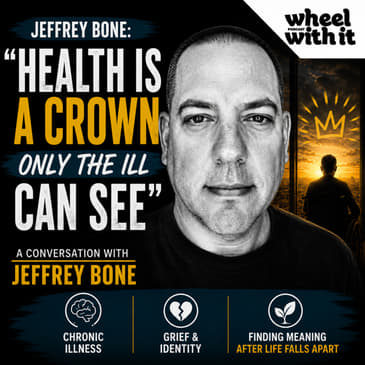
Jeffrey Bone: “Health Is a Crown Only the Ill Can See” | Wheel with It Podcast
What happens when a psychologist who has spent decades helping people with chronic illness suddenly becomes chronically ill himself?In this powerful episode of Wheel With It, Jeffrey Bone shares his deeply personal journey through chronic illness, chronic pain, grief, identity loss, mold exposure, immune deficiency, and rebuilding his life from the ground up.Jeffrey opens up about:- Living with chronic inflammatory response syndrome- Being diagnosed with common variable immune deficiency- How chronic illness changes your identity- The emotional reality of long-term illness- Why poetry became his outlet for pain and healing- The importance of online disability & chronic illness communities- Finding meaning after life falls apartThis is an honest conversation about resilience, mental health, disability, and the emotional side of being chronically ill that most people never see.
🎙️ Guest: Jeffrey Bone
📲 Connect with Jeffery:https://www.drbone.live/
📺 Subscribe to this channel and hit the bell, or visit getwheelwithit.com to subscribe on your favorite audio platform.
📲Follow the podcast and Devon Wieters on social media at wheelwithit.com/followus👍 If this conversation resonates with you, please like, subscribe, and share.
#ChronicIllness #Disability #MentalHealth #ChronicPain #WheelWithIt
TIMESTAMPS:
00:00 Introduction & Jeffrey Bone’s powerful opening quote
01:00 Meet Jeffrey Bone
02:00 Developing a chronic illness after helping others for decades
03:00 Devon shares her experience with vertigo
04:30 The fear and uncertainty of sudden illness
06:00 Losing your old identity after chronic illness
08:00 Grieving the healthy version of yourself
10:00 How illness changes relationships and daily life
12:00 Doctors dismissing symptoms as psychological
14:00 Discovering toxic mold exposure
16:00 Searching for answers & finally getting diagnosed
20:00 Living with an immune deficiency & weekly infusions
22:00 Finding creativity and meaning through illness
23:00 Why Jeffrey started writing poetry
25:00 What people misunderstand about chronic illness
27:00 The emotional reality of “forever” diagnoses
29:00 Online communities, disability support & advocacy
31:00 Why asking for help matters
32:00 Jeffrey’s podcast, books & where to connect
33:00 Final thoughts & outro
Subscribe for more inspiring conversations:https://wheelwithit.com/youtube to subscribe on YouTube. You can go to getwheelwithit.com to subscribe on your favorite audio platform! If you subscribe on an audio platform and the app allows it, please be sure to leave a five-star rating and review. It really helps people find the show! If it's available wherever you subscribe, hit the bell so that you get notified when we upload new episodes!
Follow the podcast and Devon on social media at wheelwithit.com/followus.
Please note that ChatGPT was used to come up with questions for this episode
subscribe by going to wheelwithit.com/subscribe
[00:00:00] Jeffrey Bone- We Have To Grieve That Old Version Of Us and Grief Is The Very First. How Can I Have All Of This Inside Me, But To You It's Just Words, Places. Jeffrey Bone- Health Is A Crown That Only The Ill Can See. And They Don't Because They're Healthy, They Have This Crown. They Don't Realize They Have This Crown, But In Truth If You Live Long Enough Everyone Is Just Pre-Disabled.
[00:00:27] Jeffrey Bone- Poetry Is Anesthesia For The Crack Of My Soul. Jeffrey Bone- Welcome To Wheel With It. I Am Your Host, Devon Wieters. Let's Get Into The Episode. Devon Wieters- Hello, Hello. Welcome To Another Episode of Wheel With It. My Name Is Devon Wieters and Today We Have A Fascinating Guest With Us. His Name Is Jeffrey Bone and He Studies The Interaction Of Psychology And Mental Illness.
[00:00:53] So I Am A Chronic Illness. I Am Really Excited For Him To Tell You About Himself. How Are You Jeffrey? Jeffrey Bone- I Am Doing Very Well. Thank You Very Much For Hosting Me Today. I Appreciate It Very Much. Jeffrey Bone- So Tell Us About You And What Got You Into This And Then We Will Get Started. Jeffrey Bone- For The Past Two And A Half Decades I Have Been Working With People With Chronic Illness, Chronic Pain. And About 10 Years Ago, I Developed My Own
[00:01:23] Chronic Illness. It's Like The Universe Wanted Me To Get A Little Extra Education In The World Of Chronic Illness. And That's Where I Had Black Mold In The HVAC In The Office Where I Was Triggered Something Called Chronic Inflammatory Response Syndrome, Which Then Triggered Is Like A Domino Effect. Thanks To Epigenetics Triggered A Primary Immune Disorder Called Common Variable Immune Deficiency.
[00:01:49] And That's Where I Became Extremely Ill For Many Years. And It Took Quite A Few Years For The Doctors To Sort That Out. And Through That I Have Had To Rebuild Myself And Rebuild My Life And Rebuild My Story. I Know A Little Bit About What You're Saying Because I Didn't Have Anything As Nearly As Nearly As Serious As You. It Ended Up Being Very Modern And Very Fixable.
[00:02:13] But I Had About Six Months Ago I Had A Dout With Vertigo For Six Weeks Or Six To Eight Weeks And I Was Scared That I Was Like Dying And That I Was Going To Die. And It Did Die Obviously And It Was Very Benign And Took Us Three Weeks Of Physical Therapy To Fix It But I Didn't Know That That That That Weeks.
[00:02:42] And I Get Because I Get Chronic Infections And Sometimes My Infections Are Sinus Most Of The Times I Have Sinus Infections And They Can Cause Vertigo At Times As Well. And It's Very Disorienting And It Really Shuts Down A Lot Of Life Because It's Hard To Function In Any Capacity When You Have Vertigo.
[00:03:03] Yes, It Was Unbelievable. And So I Know How It Feels To Be Like Okay, What Is This? Am I Going To Die? So That Must Have Been Crazy. No, You Do Get To This Place Of What Is This? No, You Do Get To This Place Of What Is This? Because The Illusion That Like Health Is Always Going To Just Continue To Roll On And We're Just Going To Be The Same Healthy Person Forever. That Illusion Shatters. And With That It's Then We Have This Unknown Story.
[00:03:31] Because We Know The Past. We Know How Life Used To Be. But We Don't Know The Rules Of The New Story Of Living With This Chronic Illness. And That's Part Of What I Focus On As A Chronic Illness Coach Of What Is This New Story Of Mine Now That I Have This Chronic Illness And How Do I Expand That Story? What Are Some Of The Most Common Psychological Struggles In People That Are New Diagnosed With The Chronic Illness?
[00:03:59] The Number One Is Going To Be There's This Issue Of Always Trying To Go Back To The Beginning Go Back To Where It Was. Everyone Wants To Strive For Not Being In The Land Of The Chronic Illness. And So There Is This Stubbornness Of I Can Get Back To This Place. And There Are People, There Are Illnesses That People Do Return Back To Their Baseline. But With Chronic Illness And There Are Many Chronic Illnesses Out There Unfortunately,
[00:04:29] People Don't Get Back. They Don't Get Back Their Healthy Self. And With That Is And Once They Realize That It Comes A Lot Of Grief. And That's One Of The Very First Places To Start Is To Realize Now We're At This Unsolvable Plan At First We Always Want To Solve What We Can Solve. But Eventually We Get To A Place We Get To A Wall Where We Can't Get Back To Where We Once Were. And So We Have To Grieve That Old Version Of Us.
[00:04:57] And Grief Is The Very First Place To Start. How Is Grieving Chronic Illness Different From Grieving Death Or Whatever? For Chronic Illness, The Grief Is The Story. It's Through Your Entire Life You've Always Had A Story Of Kind Of Who You Are. The Rules Of Who You Are. I'm Smart. I'm This. I'm Good At This. I Have This Capacity. I Have These Limitations. This Is What I Work With.
[00:05:27] The Story Of The Story Of The Story Of The Story Of The Story Of Who You Are. And It's An Internal Grief Because It's The Internal Experience Of The Sense Of Self Versus Grieving Someone Else That's Passing Away. It's Heartbreaking. It's Sad. But You Remain A Constant Fixture. You Hurt. You Ake. You Miss That Person. But It's A Little Bit Different When That Person Is The Identity Of You And The Story Of. Chronic Illness Often Bring Fullerliness.
[00:05:57] And A Feeling Of Being Misunderstood. Why Do You Think That Experience Is So Common? Because Ultimately Pain Cannot Be Shared. I Love The Quote By David Foster Wallace That Says, How Can I Have All Of This Inside Me? But To You It's Just Words. It's Like You Can Feel That Ake And That Heartache, That Love, That Fear, That Pain, All Those Different Things. But The Only Thing That You Have To Share With Somebody Else, It's Just Words.
[00:06:26] And So Some Things Cannot Be Perfectly Shared In Terms Of The Experience Of It. And Sometimes People Can Relate. Getting A Bruise, A Sprained Ankle, Some Common Kind Of Things. But When It Comes To Chronic Illness, Chronic Pain, People Don't Have A Reference Point For It. And They Don't Really Appreciate What It's Like To Be Living With A Chronic Condition. And A Chronic Condition That Can't Be Perfectly Shared Other Than With Words. So It Gets Misinterpreted.
[00:06:57] Additionally, You Mentioned The Fear Of Death. People Also Get Afraid. Other People Become Afraid Of Their Own Health Anxieties, Their Own Death Anxieties. And They Don't Really Like The Idea Of, Wait, This Could Happen To Me. I Could Get Sick. Because They Want To Hold On To The Idea That There's Always Going To Be A Supplement. The Doctor Will Always Be Able To Fix Them. They'll Always Be Able To Get Back On Their Feet. And They Would Try As Hard As They Could.
[00:07:26] And They Would Fix Everything. But Sometimes It Takes More Than Effort. And Sometimes When You're Dealing With Other People, They Hold On To The Illusions That Their Health Will Go On Forever And Ever. And It Doesn't. At Some Point, We All Get Ill. We All Fall Down. It May Be When You're 96 Or 97, But We All Get There. That's Honestly So True. Health Is Not Like Again, People Think Their Health Is Like Going To Last Forever.
[00:07:56] I'm Like No, It's Really Not. No, They Want To Hold On To It Because I Love The Quote, Health Is A Crown That Only The Ill Can See. And They Don't, Because The Healthy, They Have This Crown, But They Don't Realize They Have This Crown. And The Ill People Can See It. And They Can See That It Can Also Be Knocked Off At Any Point. Because They Once Had A Crown That They Wore, But They Were Completely Ignorant To It.
[00:08:26] They Were Completely Unaware Until Illness Knocked Them Down. And Ultimately Changed The Story Of Life. But If You Live Long Enough, Illness Will Find You. As They Say, There Are Disabled People In The World, But In Truth, If You Live Long Enough, Everyone Is Just Pre-Disabled. Because Everyone Will Find Disability In Their Future If You Live Long Enough. That's A Quote For Social Media, By The Way.
[00:08:55] Everyone Is Pre-Disabled, Yep. Yes. You Have Created Guided Meditation Specifically For People Living With Pain And Insomnia. What Makes Those Medications Different From Typical Mindfulness Recordings? For Me, When I Was Dealing With The Wildness Of My Body When I Was Very Sick, Like I Could Take All The Medications And I Still Couldn't Sleep.
[00:09:21] I Could Do All The Right Sleep Hygiene Things And I Still Couldn't Sleep. I Couldn't Sleep. And I Was Fighting It. And It Was A Struggle. It Was This Performance Anxiety Of Why Won't My Body Allow This To Ultimately Happen? And I Was Trying To Sleep. And So When I Created My Meditations, It'S Really Just About Allowing Whatever The Circumstance To Be
[00:09:46] It Is Focused Fundamentally On Allowing And Not Fighting, Not Resisting What Is The Reality. Whether It'S The Pain, Whether It'S Just Difficulty Being Able To Sleep, It Is About Allowing. So We'Re Not Trying To Create This Magical Place Of Now You'Re Getting Sleepy And Now You'Re Relaxed. We'Re Acknowledging The Pain. We'Re Acknowledging The Illness.
[00:10:13] We'Re Acknowledge The Symptoms And We Allow Them To Be And We Don'T Try To Magically Change Those Symptoms. But We Have This Companion Of Finding Where That Peace And Calm Is Within Us. And We Allow All Of It To Exist At The Same Time. Have You Ever Heard Of Kurt Thompson? Kurt Thompson. Let Me Think. That Name Does Not Ring A Bell. You Should Look Him Up. He'S A Psychiatrist That'S Absolutely Brilliant.
[00:10:41] He Studies The Intersection Of The Bible And Interpersonal Neurobiology, Which Is How Our Brain Works When We're With People And When We're Not. And He Talks A Lot About Chronic Illness Because Obviously He Has A Lot Of Patience With It. And He Says Exactly The Same Thing That You'Re Saying.
[00:11:03] Like We Have To Acknowledge That It'S There And Come Around People That It'S There For And Then Go Through It With Them. Absolutely. And I'M A Huge Believer Of... I Don'T Have Cures. I Don'T Have Magical Cures. I Wish I Did. I Wish I Could. I Had The Right Words, The Right Chords, The Right Whatever.
[00:11:24] But Everything That I Try To Encourage In Terms Of How I Approach This, Living With Myself And Assisting Other People, Is Always The Truth. It'S Always To Be As Authentic And Honest With Ourself But Expanding Out Our Awareness To Include Things That Maybe Our Brain Isn'T Paying Attention To. But It'S Always Going To Be The Truth. Because It Doesn'T Do Us Any Good To Gaslight Ourselves To Pretend That The Pain Is Going Away.
[00:11:52] To Pretend That We'Re Falling Asleep Doesn'T Work. So Speaking Of Falling Asleep, You Have Created Guided Meditations Specifically For People Living With Pain And Insomnia. What Makes These Meditations Different From Typical Mindfulness? And For That It'S The Same Approach. It Is This. And A Lot Of It'S Rooted If You Go Back, Way Back, It'S Buddhism And More Modern It'S Acceptance Commitment Therapy.
[00:12:18] Also Known As ACT Which Is The Third Wave Of Cognitive Behavioral Therapy. And It'S Much More Of The Contemplative Side Of It. It'S Understanding That You Are Your Awareness. You'RE Not Your Symptoms. You'RE Not Your Thoughts. You'RE Not Your Feelings. But You'RE Aware Of Your Thoughts And Feelings. You Have 70,000 Thoughts A Day. You'RE Not 70,000 Different Things. And 80% Of That'S Recycled. And A Lot Of It'S Negative. It'S Recycled From Yesterday Is What I Mean.
[00:12:47] But We Have A Lot Of Information In The Forms Of Emotions, Thoughts, Physical Sensations. And It'S Understanding That In Those Moments When We'Re Trying To Sleep, We Can'T Change That Symptom. But We Can Change Our Relationship To That Symptom. And Focusing On Changing That Relationship To An Allowing Relationship Where We'Re Not Engaged In Hostility Towards Ourself.
[00:13:17] Because Everything That'S Going On, The Thoughts, The Feelings, The Physical Sensations, It'S All Going On Inside Of Us. And So We Don'T Want To Go With A War With Ourselves. That'S Not Going To Do Us Any Good. And That'S Surely Not Going To Be Able To Relax. So We Allow, We Acknowledge, And We Welcome. Awesome. You Integrate ESTA Essentials And Acceptance Based Approaches. First Of All, What Is ESTA Essential Therapy?
[00:13:43] And How Do These Perspectives Help Someone Build A Meaningful Life When Their Body Is Unpredictable? Much Of It'S Rooted In The Philosophy Of Individuals Such As Sartre And Camus. Even Goes Further Back In Terms Of Nicolet And Also Simone De Beauvoir Who Was Quite Influential. And It Goes Back Into Those Or Three Of Those Were Simone And Sartre And Camus.
[00:14:13] French Existentialism Of The Early 1920s Or So. And Then That Got Incorporated Into The Work Of Rollo May And Then Later In A More Modern Fashion Into The Work Of Irving Yalom. The Main Components Of It Are Freedom, The Isolation In Community, Death And Mortality In Meaning.
[00:14:38] Those Are Going To Be Some Of The Main Sticking Points Of What You Would Want To Be Covering. So Again, It Is That Free Will And That Freedom And Understanding And Appreciating Where You Are Indeed Free. Where Is That Community? What Is The Experience Of Isolation? And Then There Is Death, Finitude, Mortality. And Then What Is The Meaning That You Assign To The World Around You?
[00:15:06] So Tell Us A Little Bit About Your Own Chronic Ionis And Like What The Symptoms Were And What The Diagnosis Process Was Like As Much As You're Comfortable With. Sure. At First, What Happened Was That I Had This Horrible Kind Of Headache Right Here And It Just Wouldn't Go Away. And I Ended Up Seeing An ENT, Ear, Nose, And Throat Doctor. And Prescribed A Medication As Prednisone. And Once I Took One Dose Of It, My Body Like Flipped Out.
[00:15:36] Absolutely Went Into Chaos Mode. Like Bright Red Ears. My Feet Are Vibrating. I'm Getting Rushes Of Like Adrenaline Surges Through My Chest. Can't Sleep. My Mind. I Forget Things. I Can't Remember People's Names. Lights Bother Me. Motion Bothers Me. I Have This. It's Almost Like Having A Neuro Kind Of Concussion Of Sorts. And My Bladder Hurts Of All Things. So I Had All These Physical Symptoms. See All These Doctors. And They All Think It's Psychological.
[00:16:06] They Think It's All In My Head. Or They Just Want To Focus On One Little Part Of It. But The Story Was Much Bright. And I Was Telling Them, No, It's Systemic. It's My Whole Body. Like Something's Wrong. And They Just Weren't Listening To Me. And I Ended Up Going To One Doctor, A Functional Medicine Doctor. And He Said, I Think You Have A Mold Issue Based On The Blood Work. We Did Urinalysis. Showed A Lot Of Mycotoxins. I Had An Environmentalist Test My Office. And There Was Black Mold. It's Two Different.
[00:16:36] Not All Mold Is Neurotoxic. You Can Have Mold In Your House And It Won't Make You Sick. It's Not All But Some Species Of Mold Is Neurotoxic And Can Mess You Up. And So I Had Two Strands, Two Different Types Of The Neurotoxic Mold In The HVAC, The Heating And Air Vents. And It Made Me Extremely Ill. And... Hi, I'm Doug Katz, Inventor Of The Nulu Kitchen Knife.
[00:17:04] The Nulu is uniquely shaped to work in harmony with the human body, greatly reducing the strain on muscles and joints common with traditional knives. Not only is the Nulu ergonomic, it's incredibly versatile. This knife is the kitchen MVP. Visit us at NuluKnives.com. That's N-U-L-U Knives.com to see this extraordinary knife in action and understand why we say Nulu is the knife that adapts to you.
[00:17:33] Visit NuluKnives.com and enter code WHEELWITHIT-NULU at checkout. Before we get back to the conversation, make sure you're subscribed so you never miss an episode. On whatever podcast app you're listening on right now, just hit the subscribe or follow button. And if there's a bell icon, tap that too so you get notified when new episodes drop.
[00:17:56] You can also subscribe to my Substack newsletter for updates about important disability policy at both the state and federal levels. And deeper dives into the topics we talk about on the show at wheelwithit.com slash substack. And if you want to follow both me and the podcast on social media, you can find all the links in one place at wheelwithit.com slash followers. Now let's get back to the conversation. I left that environment.
[00:18:24] And for a while I was doing the treatment protocol for chronic inflammatory response syndrome. But even after about a year or so, I just, I was better, but I still was not feeling well. So I was going to go to the Mayo Clinic. I was just, but before I was going to go, I was like, why do I look at the hospital directory? Let me see if there's something in the hospital directory where I can find a different department that I haven't gone to. Because I'm looking for a Dr. House.
[00:18:53] I'm looking for the mythical TV character that's going to solve everything for me. But I go through the list and I find one that says toxicology. And I'm like, you know what? I don't know what that is, but I feel toxic. And so I go to this person and he doesn't believe in the mold thing. He doesn't think I was sick from the mold. He thinks I was a bunch of hogwash, but I don't really care. I just want him to listen to me.
[00:19:19] And so he goes then and does a lot of blood work on me. And from that blood work, I could see that there was low immunoglobulins. And immunoglobulins come out of your bone marrow, make a part of your immune system. And he sent me then to an immunologist. And then the immunologist gave me a vaccine. And so he gave me a vaccine.
[00:19:47] And it wasn't to cure my illness. It was to see if I was going to make antibodies to it. And a month later, I go and do the blood work, come back. And I find out that I did not make the antibodies to the vaccine. So the low immunoglobulins plus not making the antibodies gives me the diagnosis of common variable immune deficiency.
[00:20:10] And on a weekly basis, I have to infuse immunoglobulins in to be able to have some of my immune system back. There are parts of my immune system that I can't replace, such as IgM. But I can replace some of it from the immunoglobulins that I infuse. Oh, do you have to go to the hospital every week for that? No, I have it at home. So there are people that sometimes go to infusion centers for it.
[00:20:40] But what I do is I put two needles into my sides and to kind of like the fat on the side of my abdomen. People can do it in their arms or their legs, their thighs. But where I have the most fat would just be in my abdomen. So I put two needles in my abdomen and it takes a little while. I'm used to it now. I don't love doing it, but it's better than not having an immune system.
[00:21:07] So I put two needles in and I have kind of an infusion pump as I just hit the microphone and screen. It's about this big and then that infuses the medication over the course of about an hour. So you just have to sit still for an hour? Technically, I could walk around and do things. I usually just sit in bed, play on my phone. But that's also what inspired me to find different ways to be able to create.
[00:21:35] I've created with poetry, with coloring books, with journals that I've written for people to write their own chronic illness journey. And I've put together things and I have looked for ways to be curious and to really discover more in my life. And so sometimes things have to slow down, things have to be different for me to find new things in my life.
[00:22:04] And that's exactly what happened is that I found new things in my life when everything fell apart. So speaking of poetry, how did poetry become the way you process and communicate the experience of illness? For me, I remember just sitting in a gym and I was just sitting there and I was full of emotion. I was full of sadness. I was full of grief and anger.
[00:22:30] And in some ways, I just wanted to yell at the top of my lungs while I'm crying. That's really like how I felt. And I've never thought I would be great at writing prose, writing a typical novel. Because throughout my life, I've talked to people with chronic illness. And I've just talked in shards. I've talked in pieces. I have a few words for people here and there.
[00:22:57] And the few words approach really fit into the idea of poetry. And I had never written a poem before I was ill. I just was hurting. And it just hurt less. It felt better. It was my version of journaling. And I wrote two books. And they're not going to help other people magically cure their illness. But one is broken bone and the other one is carved out of bone.
[00:23:23] And those are the two books that I wrote, which are almost just like my personal journals of sorts. Of just me being sad, angry, scared, and all the rest. And so I was this teapot. And it was whistling. I needed to unleash some of the pressure. And poetry was the way that I was able to find a way to have that voice. And that way of being able to have that cathartic response.
[00:23:53] It was just that it means this emotional release of this information out of my body. And poetry was the vehicle that I used. So what surprised you most about being on the other side as a patient? I don't think that people understand the word chronic. I think people know what it is to be ill. They're like, oh, I've had the flu. I've broken an arm. I've had these different things. But when things become chronic and the idea is forever, it's forever, ever.
[00:24:22] And people don't really appreciate forever, ever. And they don't appreciate how you lose a sense of who you are. You lose a sense. Now, there is more to grow. There's more to expand. And there's more to be in. And it's not the end of you. But it's never going to be the same you. After you develop something that's chronic, things will change in your life.
[00:24:51] It could be relationships, friends, or a sense of self. Because your capacities change. How you see yourself change. How you see your future changes. And I didn't really appreciate how chronic really got into the story of life. Because the doctors, well, you go in, you talk to them a little bit, five, ten minutes. They're like, okay, we'll give you this medication. Is this better? Is this worse? This and this.
[00:25:16] But for me and when I work with people, it's the story of who you are after this illness. And I don't think people understand. And that's the existential side. The humanistic side of what it is to be this person now. Continuing to live. Continuing to choose to persist in this world. Despite the difficulties that may be there. And that you find something more.
[00:25:45] And so I was surprised. Even though I knew it. You don't really truly know it until you get there yourself. Yeah, that's so true too. How does chronic illness change someone's sense of identity as you referred to earlier? It all of a sudden becomes shaky. It can become unstable. Because there's this illusion that everything's just going to go on as it's always. Or always has gone on.
[00:26:14] And it's just going to continue. And so that idea shatters. And it impacts people in a lot of different ways. Because I use the word chronic illness. But I mean, it doesn't matter if it's muscular dystrophy. It doesn't matter if it's POTS or fibromyalgia. Or an autoimmune or primary immune disorder. Everyone's going to be different. Everyone's going to have a different impact on what their capacity is. Whether it's a fatigue or energy. Brain fog.
[00:26:44] Or maybe it just, they love to sow. They love to garden. But now due to rheumatoid arthritis. They don't get to be that person anymore. So it's that shift of, I can't be who I've always been. And I can't be who I thought I was going to be. So who am I going to be now? What's the story of my life now? And that's what it is. And again, and that's also why I wrote journals. These journaling books. I have two. One is Breath Between Battles.
[00:27:13] And the other one's called The Expanded Life. I never thought I could write a book about chronic illness to tell somebody, this is how your life should be. It's much more like, I like having the space and the questions for people to ponder it for themselves. Because there's no one yellow brick road. There's no one answer. There's no one way to go about this. Everyone is on their own unique journey with this. And so that's why I've always liked the journaling.
[00:27:42] And if I was going to write more books, there would be more journal books. Because you know what? I don't have the magic answer. But I'm the guy that can help explore what may serve you or what may serve the next person in terms of having a better life and suffering less. So for someone with a chronic illness right now, what advice would you give them? I believe in solidarity. I believe that we should be doing this together.
[00:28:11] I, Ram Dass has the quote, we're all just walking each other home, which means that we're all going to die. No one gets out alive, but we can do this together. I think it's important that if you have chronic illness, find the advocacy groups and get associated with those groups. Find people maybe online. Find people maybe in your community.
[00:28:38] But try to look for people because you want to connect to as many people as possible. Ask for help. It's a coach. It's a therapist. It's a doctor. Whatever it may be. It could be someone from a church or maybe someone has a religious spiritual path that they're on. It's Facebook groups as well.
[00:28:57] Like you can Google pretty much any, not Google, but like search on Facebook, pretty much any conditions and then hit the group tab and there's four or five Facebook groups for it. It's amazing. Absolutely. Absolutely. And as much as computers and social media is a major problem, anyone with a chronic illness or a disability, it really can serve them very well of finding a community.
[00:29:24] And the fact is I can't walk out my door and find a bunch of people with a primary immune disorder, but I can find those people online. And those people do exist online and we can root for each other. We can bring things up. We can talk about things. And, but when it comes down to it, ask for help, seek help. Don't feel like you have to do this all by yourself because you don't, because there are other people.
[00:29:51] There are people that are being diagnosed with your issue today. There are people that have been diagnosed for the past 10 years. I've had my primary immune disorder diagnosis for the past 10 years. And so it's asking for help is probably in being humble and knowing that you don't have to just do this all by yourself. And honestly, community is so important. There are some bad Facebook groups out there and some bad communities out there.
[00:30:20] But like a good example is in this, not this community is not as good as it should be either. I'm just like using as an example. I wish it was better, but I'm on a Medicaid waiver. And by the way, if you need a Medicaid waiver, go to Medicaidwaiver.org to find out what Medicaid waivers are available in your state. And then go to your local community service board to apply for one.
[00:30:50] And they'll help you get started. And you can just Google community service board and use a code and it'll come up. Very nice. Very convenient. That's good advocacy. Advocacy is huge. And that's what you just did. And there's somebody who's listening to this and they're going to look it up right now. And then you are contributing to the community by advocating. And that's wonderful.
[00:31:13] And so there's for the families that are on, because some adults have it and some kids have it, like parents of applied. Like on behalf of their kid, cause they're giving us something. And so there are constantly questions in their life. We need this. And they said we couldn't get it. How did you navigate this?
[00:31:35] Or is this normal or so like people that have been through it can often give you more solid answers than the experts. Yes. Yes. They were trying to navigate the, it just purely online and just trying to click the right boxes. Yeah. Where can people connect with you? If they're interested in working with me or they want to know, I also have a podcast called To The Bone.
[00:32:05] It's conversations on pain, illness, and meaning. It's just, they're just solo episodes. So I'm not interviewing anyone yet, but someday I probably will. But to, for people to find me, if they want to work with me, they can go to drbone.live. That's where I have all my books and all the information about. Yeah. And we'll have all those links in the show notes as well. And can we close with a piece of your poetry?
[00:32:35] Now, I don't ever speak my poetry out loud. So if I fumble, it's just a part of me being an imperfect person. So this one's called Broken. Sharing my break, no hairline or full, hurts like the devil as I continue to fall. A few x-ray eyes, my friendly spies, diagnose and treat, they still want me around. Poetry is anesthesia for the crack in my soul. Immune disorder, chronic pain, insomnia, and more.
[00:33:04] Round out the story, a web to be woven. Words can be weapons, but these are my stitches. Just me and my glitches. That's going on social media too, by the way. I love you, but. And you can follow us at realwithit.com slash followers. You'll find our social media links there. And go to realwithit.com to find out more about the podcast. WelfareReformNow.com to find out more about our mission to reform welfare.
[00:33:34] And we will see you guys next episode. Don't forget to subscribe, comment, all the things. Hit the bell so you get notified. If there's one available wherever you listen to get notified when we upload new episodes. See you guys next time. Bye, guys. Thank you for joining us. If you're listening on Spotify or your favorite podcast app, please be sure to hit the follow button. And if available, the bell to get notified when we upload new episodes.
[00:34:03] It really helps support the show. Also, if you're on Spotify, please leave us a comment. If your podcast app allows you to, please rate and review us. It helps more people find the show. Remember to follow the show and our guest on social media using the links in the show notes. We'll see you next time.