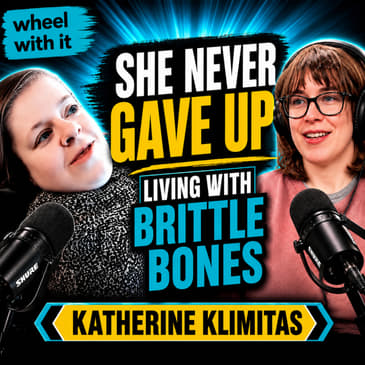
What is it like living with Osteogenesis Imperfecta (OI), also known as brittle bone disease?
In this episode of Wheel With It, Katherine Klimitas shares her journey growing up with Osteogenesis Imperfecta, navigating life as a wheelchair user, building a successful art business, and finding confidence in a world that often underestimates people with disabilities.
Katherine discusses her childhood, education, experiences with disability awareness, chronic pain, entrepreneurship, and how watercolor art became both a passion and a career.
If you’ve ever wondered what life is really like with OI, this conversation offers an honest, inspiring, and eye-opening perspective.
🎨 Learn more about Katherine:
https://kakartnola.com
https://linktr.ee/kakartnola?utm_source=ig&utm_medium=social&utm_content=link_in_bio&fbclid=PAZXh0bgNhZW0CMTEAc3J0YwZhcHBfaWQPOTM2NjE5NzQzMzkyNDU5AAGn1_vAu84Z2tk1JFUymf57XsZ2QogDdzByyedCk-QXrNR6wpW0S6ZxaXaWLwU_aem_Xc-ex0ZFBf3obQQSkt3Bbwhttp://facebook.com/kakartnolahttp://instagram.com/kakartnolahttps://www.linkedin.com/in/katherineklimitas/https://www.etsy.com/shop/kakarthttps://kakartnola.com/contact-katherine/
#OsteogenesisImperfecta #DisabilityAwareness #WheelchairLife #BrittleBoneDisease #DisabilityInclusion
Timestamps:
00:00 Audio issue disclaimer
01:37 Welcome to Wheel With It
01:44 Meet Katherine Klimitas
02:03 Living with Osteogenesis Imperfecta (OI)
02:24 Owning a business and becoming an artist
02:42 Growing up with a disability
03:21 Discovering watercolor painting
04:22 School and academic success
06:00 Disability awareness and public reactions
09:30 Building a career in graphic design and art
13:15 Entrepreneurship and self-employment
17:40 Life as a wheelchair user
21:15 Disability misconceptions
24:30 Independence and accessibility
28:00 Chronic pain and daily challenges
31:18 Disability benefits and employment realities
31:42 Living with chronic pain
32:19 Where to find Katherine online
33:06 Pet portrait commissions and artwork
33:32 Final thoughts
34:06 Outro
subscribe by going to wheelwithit.com/subscribe
[00:00:00] Hey, just a heads up that we did have some audio issues in this episode. We did our best to fix it, but we did have some audio issues in this episode. So occasionally the video cuts out for a few seconds and you hear AI generated audio where the audio completely cuts out. And then there are some little tiny cuts throughout the episode. But we did our best to fix those and you can still get the gist of what she's saying.
[00:00:26] It breaks my heart when we have technical issues like this, but this is a really good episode. So please hang in there with us and we're sorry for the inconvenience. The gist of bone disease is called osteogenesis imperfecta, which basically means that my bones break easily and they grow abnormally. So I'm actually only 2'7". I use an electric wheelchair to get around.
[00:00:47] When adults stare, it drives me crazy they should know better. And I just stare back at them. And so I make them really uncomfortable because I just stare back at them as long as they stare at me. Fascinating people.
[00:01:13] We'll have conversations. Roll up and roll into the moments. Every story helps us cope. Turn another page. Flip the good vibes. We just breathe and let it flow. We just wheel with it. Keep it moving. Never quit. Welcome to another episode of Wheel With It.
[00:01:41] Today we have Katherine Blamitis. We will get started. Hi, everybody. My name is Katherine Blamitis. Right outside of New Orleans, Louisiana. I am a graphic designer and artist. I have been painting since I was really young. And I paint mostly animals in water color. I have a genetic bone disease called osteogenesis imperfecta. Which basically means that my bones break easily and they grow abnormally.
[00:02:10] So I'm actually only 2'7". I use an electric wheelchair to get around. And I have an aide with me most of the time too. To help me do things that most people can do, but I can't. And yeah, I own my own business. I went to school for design and have a degree in design. And I have been freelancing for the last 10 years.
[00:02:38] So yeah, that's me in a nutshell. What was the light going up with that for you? It was hard sometimes. I had really great parents. My parents were veterinarian and so I grew up with animals, which makes sense because I loved to paint animals. But I had really great parents that tried to put me in as many normal kid activities as I could be in.
[00:03:07] But of course, I couldn't go play sports with my friends. It was too dangerous and I couldn't be around flying objects and anything like that. And I got really into art when I was very young. My mom gave me my water polter set when I was five. And from there, I just, I loved it. And so they realized that art was something that I could not only do, but also that I was pretty good at.
[00:03:36] And so they got me into all kinds of different classes and lessons. And I got to try all different kinds of art before I was even really a teenager. And so I just, that's what kept me occupied. That's what I got into instead of soccer or baseball or whatever, like my friends were. And it gave me something to focus on when there were so many things I couldn't do with my friends. But it was okay.
[00:04:05] I loved it because nobody ever really treated me as like the girl in the wheelchair. Well, I had friends, I'd been in with them and I still have some of them today. It was okay. I went to good schools and it was good. School was fun for you. I won't assume since you said that. I was going to ask what school was like for you. It was good. I was a really good student. I liked school.
[00:04:33] I liked doing well in school and I liked learning. I made basic work days throughout my whole school career, but I, or at least pretty close. But, and I was in a lot of advanced classes because again, like I couldn't go out and do a lot of physical activities. So I did a lot of mental ones. And so it was easier for me to focus on school rather than on the things I couldn't do.
[00:05:00] But yeah, I had some accommodations in school. I lay down a lot to work and to type and write and things like that. And the classroom, I had the DN, had a table that I could lay on and I had an aide with me. Of course, the bathrooms were accessible to me.
[00:05:23] But other than that, and I think I, in high school at least, I was able to leave class like five minutes early or late so that I wouldn't be in the hall with all the kids. Yeah. And with stuff like that, but relatively simple things, not any major crazy accommodations. And I was fine. I did okay. So how was college to be or how was that different? I understand.
[00:05:51] I, I went to a local college and I lived at home because it was just too complicated to try to live away from home. It was just going to be way too hard. And because I, I really do need somebody with me most of the time. And so to do that, it was just going to be really difficult. And we had, we had a few decent colleges here. So I shared one of them and it was good.
[00:06:19] I thought I was going to major in fine art because I loved art and I love making art. So it made sense for me to major in fine art. But then I realized that in order to make enough money to support myself, I would have to create a whole lot of art, like a lot of art. And physically, I was not going to be able to do that. I was not going to be able to keep up and do that.
[00:06:48] And so I ended up switching my major to graphic design. And so now I do my art, but I also work for clients. So I do logo design and branding and print stuff for businesses, social media marketing and things like that too. So it opened up another avenue to make some money, which is good. Yeah, that's always good.
[00:07:14] So how did you, how did your disability affect the way that you see the world as an adult? It affects everything I do. My, my disability is, it affects, it affects everything I do. I don't know another way without it. But there are people that have their able bodied up until a certain point, then they become disabled. Right?
[00:07:40] So then, so they know what it's like to be normal, quote unquote normal. I don't. So, I guess I like being an adult. Honestly, there was, it was harder to be a kid because I feel like there was more activities that I couldn't do as a kid that I wanted to do. I wanted to be, to do all the things my friends could do. And I wanted to be included all the time.
[00:08:10] But now, as an adult, I really don't care. Like, I like what I do and my life and I really don't care that I can't do those other things. I would much prefer to be an adult than a kid, personally. Was it hard for you later in life though, as an adult looking back on it and was like, Oh, I wish I could have done that or whatever. Or was that not? No, I had to be a little bit, but not really. I don't know.
[00:08:39] I feel like I have a really good childhood. And yeah, I had some challenges. There were a lot of days where I had a lot of pain and I was broken and I couldn't move around. But I also knew a lot of things my friends didn't. And I don't really look back on it and say, Oh, I wish I could have done that. I don't really have that at all. That's cool that you don't have that.
[00:09:06] That's really great that you have that because a lot of people do have that. Yeah. Yeah. I don't know. I try not to live with regret or anything like that. I'm a very, I try to be practical. I try to live as much as I can in the moment, but also, and I'm sure you understand this, because I had a disability, I have to plan. I have to plan.
[00:09:34] And if I want to go do something out of my house tomorrow, I have to plan to have somebody somebody who can drive my car, somebody who can move me around. I just, I try to look forward and not backward. For those who don't know, I just started using this. It's called Podmatch. And on Podmatch, it has the guest profile, has questions that they're all always ready to answer.
[00:10:01] And one of them is, for you, is how do you find strangers react to you in public? I'm sure you have some crazy stories because I have crazy stories. So, get into that and then tell us what's the craziest reaction you've gotten. Well, I don't know about the craziest. I've had people want to pet my head. That's really weird. I don't like that at all.
[00:10:28] I had people, a lot of times people think I'm a baby, which really aggravates me. They'll say, oh, I've been precious. And I'm just like, no. That's aggravating. I had people stare at me, which I'm sure you understand. And I don't really mind when kids do it. Kids are, they're curious, right? I love answering kids' questions. Of course. They're so awesome. Yeah.
[00:10:56] I love it when people ask questions. But when adults stare, it drives me crazy. They should know better. And I just stare back at them. And so I make them really uncomfortable because I just stare back at them as long as they stare at me. And it works. I'm gonna, I'm gonna do that. And it scares them and they run away. I like doing that. But yeah, I've had kids say, oh, mommy, it talks.
[00:11:27] It talks. It talks. I've had people say, oh, it drives itself. Right. Right. Oh yeah. I've had people say some really stupid things. I'm sure that you've gotten this. I get the, oh, you're gonna get a speeding ticket. Do you get that one? I don't know. But all the time. I love that one too. All the time. Or do you have a license to drive that? That's the other thing. All the time.
[00:11:56] All the time. And people think that it's funny. But I'm like, guys, do you know how many times I've heard that? I've heard it so many times. And then when I have a cup holder for my drinks. So when I'm drinking something and driving, there's a drink. Oh, I know. I get that too. I get that too. Yeah. But it's ridiculous. And what cracks me up is that people think they're being created and they're being funny.
[00:12:25] And I'm like, this is cold. You know how to walk with a Nala meter? You're not being created. This is not new. So anyway. I've heard some dead ones. Hi, I'm Doug Katz, inventor of the Nulu Knives. The Nulu is uniquely shaped to work in harmony with the human body, greatly reducing the strain on muscles and joints common with traditional knives. Not only is the Nulu ergonomic, it's incredibly versatile.
[00:12:54] This knife is the kitchen MVP. Visit us at NuluKnives.com. That's N-U-L-U Knives.com to see this extraordinary knife in action and understand why we say Nulu is the knife that adapts to you. Visit NuluKnives.com and enter code WHEELWITHIT-NULU at checkout. Before we get back to the conversation, make sure you're subscribed so you never miss an episode.
[00:13:22] On whatever podcast app you're listening on right now, just hit subscribe or follow button. And if there's a bell icon, tap that too, so you get notified when new episodes drop. You can also subscribe to my Substack newsletter for updates about important disability policy at both the state and federal levels, and deeper dives into the topics we talk about on the show at wheelwithit.com slash substack.
[00:13:47] And if you want to follow both me and the podcast on social media, you can find all the links in one place at wheelwithit.com slash follow us. Now, let's get back to the conversation.
[00:14:38] You get into art and what was the progression from hobby to career? We kind of already talked about that. Yeah, I can tell you a little more in detail. Like, when I was really young, my mom was constantly trying to find things that I could do, because I was really bored, and I was really smart, and I was driving her.
[00:14:57] So, she gave me my first watercolor set when I was about five, and I loved it, and I went through it really fast. And she realized that art was something I really enjoyed and could do.
[00:15:14] And she got me into all kinds of classes. Of course, I had art in school, but then I also had summer camps and private art classes and other types of local art classes.
[00:16:12] And I just, I really liked it. Everything I did, it was creating. I loved it. And I used to have to, I mentioned my parents were veterinarians, and I used to have to go to work with them on the weekends, on Saturdays, when I was really little.
[00:16:31] And so, what I would do to keep from being bored is I would sit in the waiting room with the client and paint their knobs while they waited, because I was just to be, just to have fun. Did that give me a jumping business? Eventually, they started paying me to do it. Eventually, people would ask me, oh, can you paint my dolls? I'll give you $20 per space. Okay.
[00:16:57] And so, I learned really quick that I could make money doing it. When I was only 11 or 12, I was young. And so, that's what started. I actually sold my first painting when I was 10. And yeah, and from there, I was like, oh, I can actually make money doing this. And I really, and so I, I really got into it at that point.
[00:17:25] And, and I knew, I didn't know exactly how art was going to shape my career, but I knew it was going to be part of it. I didn't know exactly what was going to happen, but I knew somehow my career was going to focus on art. And yeah, I was kept at it. And like I said, I eventually went into graphic design in college and that's kind of where, you know.
[00:17:51] And before that though, I was doing pet portraits and paintings for people professionally. So I had started my business in high school and then branched out after college. Talked a lot about your parents. Tell me more about your relationship with your parents. Oh, I have great parents. My, my dad had to lay in 2012. Oh, I'm sorry.
[00:18:19] Oh, it's okay. He had a genetic lung disease. So he was actually sick most of my life, but he was a very good veterinarian, very talented veterinarian. And he did a lot of orthopedics in veterinary medicine. He loved music. He was very smart and he is a good person.
[00:18:42] He had his moment. He had a bad temper sometimes and he could be a little difficult, but most men can. But yeah, he was great. And he had to retire because of lung disease. He had to retire early and he ended up having double lung transplant when I was like a teenager. Oh God. Yeah. And he lived another eight years past, but he did okay. He did well.
[00:19:11] Well, my mom is also a veterinarian and she is a homeopathic veterinarian, which means that she does a lot of natural medicine. So she does a lot of homeopathic remedies and herbal medicine and Chinese herbs and things like that.
[00:19:29] And she does a lot of nutrition, that kind of thing. I always grew up in a pretty healthy household. We've always eaten well. And she, it's been really good because she has natural remedy for pain, which is great for me because, you know, I don't like to take a lot of drugs.
[00:19:52] I don't either. I don't even take Advil unless I'm dying. So I do take some Advil. I take Advil and I take, etc. And if that's really bad, I don't take a lot of narcotics or anything like that. Nothing really hard anyway.
[00:20:11] So yeah, so I take a lot of natural remedies and things like that. And that's been really good. And the fact that they were veterinarians and they had medical knowledge was really helpful for me growing up because I broke bones all the time when I was little. And so that wasn't, it was stupid to go to the hospital. Every time I broke a bone.
[00:20:38] You knew what was broken. We knew how to fix it. You know? Yeah, like how to blend it. Yeah. Yeah. And so my parents had access to the material we needed for my bones and stuff. So it was good that they were in the medical school. Also, my grandfather is a family doctor. So that was good because we did have a doctor in the family. So yeah, I'm very lucky that I grew up with the parents I did.
[00:21:09] Wow. Yeah. You are very lucky that you had all those doctors because the family, that must have been a big help. Yeah. So speaking of in, like you said earlier, what's dating like for you as much as you're comfortable with? I mean, I'm my wife. I am focused on getting my business up and running like the way I want it to be. And I just, that's my focus right now.
[00:21:35] I'm not against it, but I'm also not actively seeking it out. And honestly, I don't get out enough to meet somebody really. I work at home. I live at home. I do go out some, but not all the time. And it's not something, it's not something I feel like I need in my life. I'm pretty happy to be where I am.
[00:21:59] So speaking of dating and stuff like that, have you seen Patrice Ramudi? The what? Patrice Ramudi. No, I haven't. Have you heard of it? No. It's about, it's on Lulu. It's about at least two people that want to live together and get married, but they can't because they're both on Medicaid and disability benefits. Oh, wow. The way the benefits work, they can't even live together or get married. So.
[00:22:29] Wow. Please watch that. I'm always plug the trees. Yeah, definitely will. It's hilarious. It's not sad. It's hilarious. Okay. Some of it's sad, but a lot of it's hilarious too. How do you think that you're able to be a successful businesswoman despite your challenges and what's been different from an able-bodied person running it? I have to adapt everything I do for me.
[00:22:56] Right. So I, part of the reason I chose not to take a job in a design firm is that I really needed to be able to work at home. I really needed to be able to set my own hours. And when I hurt, when I had bad things, I needed to be able to lay down and use my, I had these beanbag contracts that I used to help me when I had a lot of pain. I needed to be able to use those.
[00:23:26] And I had somebody with me all the time. And so all of those accommodations are really hard to have in an office setting. So I chose to open my own business, but I also grew up with two parents who own their own businesses. So it's not like that was a foreign idea. I watched them. I watched them do open a business. I watched them do the tax paperwork.
[00:23:55] I watched them hire employees. I watched them do all that as I grew up. And so I was already familiar with what went into owning a business. Yeah. And they were also there to help me, which was good. And my mom still, although she doesn't tell me much with my business. But that's it. Yeah. I was really lucky because I had a lot of good support.
[00:24:20] And I learned over the years that the best thing you can do when you have a business is hire a good team. You want to have good people working with you. People who are not only good people, but they're also, they also know what they're doing. They do their jobs. They don't take advantage of you. They don't feel from you. Things like that. And that's really important.
[00:24:47] I don't know that it really is any more difficult as a disabled person. I guess in a way it is because when I hire employees, they have to be able to move me around and help me. So it's harder than hiring a secretary. Yeah. Like it's not a secretary. No. No. It's harder than that. Like right now, actually, I'm trying to hire a new employee.
[00:25:14] And it's been very difficult finding somebody appropriate for the job. And I think I actually found somebody yesterday though. So I'm very excited about that. If you don't mind me asking, how much do they pay down there? Because I assume you're on Medicaid waiver also. No, I don't. I pay out of pocket. How do you manage to pay out of pocket? I work really freaking hard. I work really hard.
[00:25:42] When I tell you I work all day every day, I work all day every day. So you just try to keep making money. I have some savings when I can't make payroll. I can dip into that. But I tie really hard not to. Like this last month, I was sick. I had the payroll for. And so like this month, I didn't work as much. So this month is going to be a little harder.
[00:26:12] But yeah, it's really what I get from my cell phone security disability and what I make, what I make when I work. I usually can make it work. That is amazing. I, we don't have very many listeners yet. I'm trying to go ahead. But if any able-washed people are listening to this in the future, I want you to know how amazing that is.
[00:26:39] Because those aids, if you want to keep them, are not cheap. No. And our state does not pay much at all. No. I don't know how much your state pays, but our state pays like only $13 something an hour. I've been doing it last year. But it's amazing that you're able to pay without all those Medicaid benefits. That's amazing. The thing is that the part of the problem,
[00:27:08] and I'm not trying to be, and I don't want this to sound bad, but part of the problem with the state situation is that because they pay so little, they don't get people who are necessarily a qualified job or each trustworthy. When I have to have somebody... Mine is consumer-directed, but still they only pay $13 an hour, even if it's consumer-directed,
[00:27:37] which means you can hire whoever you want. And they're paid to the state. And so you don't get people... You don't get good people in general. And so it's not the bad... It's not a great program. Let's put it that way. No. It's not well done. So I choose to not participate in that. Wouldn't it be easier financially? Yeah, of course.
[00:28:04] But I want to make sure that I get the people I want A and B, that they're paid well. I want them to be taken care of too because they require things already. That's amazing that you're able to do that. I have to get there one day. You touched on school in the beginning, but how do you think going to a mainstream school affected you and did it affect your classmates and teachers any? Oh, yeah. I'm a big proponent of school inclusion.
[00:28:34] I think it's really important for kids, able-bodied kids to see people look different than they do early, young children. Because one of the things was that my class was around me. They were around me from the time we were like six or seven to high school.
[00:29:02] And so they don't care at people in wheelchairs. They know to talk to people in wheelchairs and not their aides. They know how to act. And because they were around me, and one of my friends and I were having this conversation the other day, and we've been friends since we were in first grade. And she said, Growing up, you were just Catherine. You weren't the girl in the wheelchair.
[00:29:31] You weren't disabled. You weren't anything. You were just you. And it affected the way that she sees other people now as an adult. And that's really important. And for me, if I was put in a class with just a bunch of people in wheelchairs, I wouldn't know how to act socially with other people. That, that's really important. Because the majority of people in the world
[00:30:01] are not in wheelchairs. That's just the way it is, right? It was good for me to learn how to interact with people who were able-bodied and thrilling. And to learn my limit and to learn what I could do and what I couldn't do. And all of those kinds of things early. Because it, it really helped me also as an adult. What is one thing you would say to an able-bodied person that they may not know about having a disability that they wouldn't think about?
[00:30:31] I think sacrability is something that people who can walk don't think about. Yes. Well, they don't, it's not a need for them. They don't have to say, ooh, is the bathroom big enough? If I go to a restaurant, am I going to be able to go to the bathroom? Is that going to, is that going to affect how much I drink at lunch? Because if I drink too much, I'm going to have to go to the bathroom and what if I can't use it?
[00:31:00] That's something. And then even, not just restaurants, but racers that have a step at the pub. That's not accessible. There's a pub. And people who can walk don't think about that. They just, they're like, oh, I just stepped up. Good for you. But I can't do that. And yeah, to say, oh, you can just, why don't we work full time? You're so smart. And it's the services
[00:31:30] and all that stuff can't be like the limits you have to be under. Yeah. I do work full time, but there are times where I can't. Right. Because of it, it's subject to anything. Yeah. Yeah. People who don't have chronic pain can't understand what it is. They just can't. They, until you have it, you don't understand what being in pain is like all the time. It's exhausting.
[00:32:00] And it makes you very tired. It makes you worn out. I'm not complaining here. It's just a fact. It's just, if you don't experience it, you don't know what it was. And that's just, it's just the way it is. Yeah. Anything else you want to add before we get off here? And where can people keep up with you? So I, my website is artnola.com You have all those
[00:32:29] links in the show notes. Okay. And then I'm also on Facebook and then, but you can follow me on all those. I have an Etsy store. So if you want to buy some of my art, I put my art on a lot of products. I have things like mugs and beach towels and blankets and all kinds of stuff for sale in my Etsy store. So you can go check that out. And what's your Etsy? It's also Cap Art Noah. It's the same. Hey,
[00:32:59] but you can get to it on my website. Okay. You'll see it. Yeah. But yeah, it's cool. You can also commission a pet portrait. So if you have a pet that you love that you want to commemorate in a painting, you can contact me through my website and you can commission a pet portrait. And they make really good gifts too. So if you're looking very good for somebody, I would recommend that. And yeah, that's about it.
[00:33:29] That's about all I got. It's been a blast having you on. You've been amazing. You're delightful. And don't forget to comment, subscribe. You can subscribe to the podcast at realwithit.com slash subscribe. and you can leave us a rating and review at realwithit.com slash review. And hit the bell on Spotify and YouTube. If you subscribe there
[00:33:57] so you get notified about every new episode and we will see you that next episode. Bye bye. Thank you for joining us. If you're listening on Spotify or your favorite podcast app, please be sure to hit the follow button and if available, the bell to get notified when we upload new episodes, it really helps support the show. Also, if you're on Spotify, please leave us a comment. If your podcast app allows you to please rate and review us.
[00:34:27] It helps more people find the show. Remember to follow the show and our guests on social media using the links in the show notes. We'll see you next time.