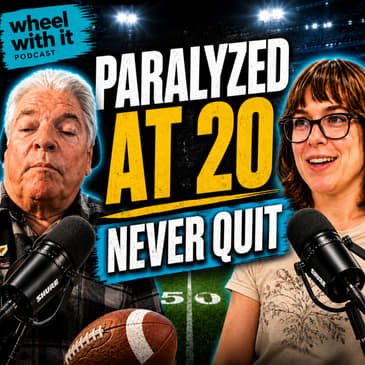
Quadriplegic Lawyer, Father & Author: Kenneth Kunken’s Incredible StoryWhat does it take to build a successful life after a devastating spinal cord injury?In this inspiring episode of Wheel With It, Kenneth Kunken shares how a football injury at Cornell University left him a quadriplegic, nearly paralyzed from the shoulders down. Despite immense challenges, Ken went on to become a prosecutor, attorney, author, husband, and father of triplets.Ken discusses life after injury, law school with a disability, building a legal career, raising a family, writing his book, and the importance of perseverance, purpose, and support.This is a powerful conversation about resilience, family, disability, and refusing to give up.#Disability #Quadriplegia #SpinalCordInjury #Lawyer #Inspiration⸻Timestamps00:00 – Kenneth Kunken’s life-changing spinal cord injury00:43 – Introduction and welcome00:55 – Football injury at Cornell University01:24 – Life as a quadriplegic and daily challenges01:57 – Marriage and navigating disability02:39 – Becoming a father of triplets03:42 – Law school with a disability04:23 – Working for the District Attorney’s Office05:01 – Why Kenneth chose criminal law07:26 – Lessons from a legal career08:44 – What keeps him motivated every day09:45 – Raising triplets as a parent with a disability10:43 – Writing his book and sharing his story11:29 – The long journey to publication15:08 – Where to find Kenneth’s book15:46 – Disability policy, benefits, and advocacy16:10 – Thoughts on marriage and disability rights16:45 – Final thoughts and encouragement
subscribe by going to wheelwithit.com/subscribe
[00:00:00] I actually had a spinal cord injury in 1970, so a little over 54 years ago. Broke my neck playing in a football game for Cornell University and as a result, I'm a quadriplegic. I'm almost totally paralyzed from the shoulders down. Now what keeps me going is that I'm also a father. I have three wonderful sons. What motivates me every day is knowing that I have three incredible
[00:00:26] children. I love being their father and it motivates me to be the best father I could be. Welcome to another episode of Wheel With It. I'm your host Devon Wieters and today we have Kenneth Kunken on the pod with us. How are you today, Ken? Doing just great, Devon. Thank you so much. So tell us about yourself.
[00:00:55] Okay. I think what your listeners may be most interested in is I actually had a spinal cord injury in 1970, so a little over 54 years ago. I got hurt. I broke my neck playing in a football game for Cornell University at the beginning of my junior year. And as a result, I'm a quadriplegic. I'm almost totally paralyzed from the shoulders down. Wow. That's, that must be hard to adjust it to. How is that?
[00:01:24] Sure is. I spent nine months and 20 days in various hospitals and rehabilitation centers. Following my insurance. What's the hardest thing about living video that like an able-bodied listener probably wouldn't know? Actually, the fact that I'm so dependent on others for all of my activities for daily living. There are very few activities I could actually do for myself. So I need assistance with everything. And I would say that's the most difficult thing to get adjusted to.
[00:01:52] So yeah. Have you guys tried some of the smart home stuff? No, I've been fortunate that I'm currently married and my wife handles my total physical care. And I've been very fortunate that way. How did you guys manage to be married with the way the benefits in the setup? I actually didn't qualify for those benefits, but I was fortunate that at the time of my injury, my father had
[00:02:18] me well covered under his insurance policy. He had a major medical policy and I was still considered a minor when I was hurt. I was 20 years old and fortunately through his policy, I had received health care coverage up until I got married. That is amazing. So what keeps you going every day? Now what keeps me going is that I'm also a father. I have three wonderful sons. The names are Joseph, James and Timothy,
[00:02:47] and they're triplets. They're in their sophomore year at three separate colleges in upstate New York. That is amazing. What are they all studying? James is studying renewable energy at the State University of New York at Morrisville. Timothy is pursuing a dual major at the Newhouse School of Communications and Maxwell School of Public Affairs at Syracuse University.
[00:03:12] And my son Joseph is studying mechanical engineering at Cornell University. One of my favorite professors from when I went to college did her, I think, summer for graduate work at Syracuse. I had a lot of relatives that went there before my son James, probably aunt before my son Timothy went there. But my aunt, uncle, a number of cousins, my sister, one of our sons. We have a big Syracuse connection in our family.
[00:03:41] Please tell me what it was like in law school with a disability where you had to have help with everything. How did you get this? It was quite a challenge. I went to law school before the age of laptop computers. So this was well before then. I graduated from law school in 1982. So it was quite a while ago. So it was difficult. It was a lot of reading. And I have difficulty even turning pages of a book.
[00:04:08] And it was difficult doing legal research because, again, this was before laptop computers. So we actually had to use the books to do the research. So it was quite a challenge. How did you manage when you went to work? How did you manage getting having assistance? I ended up going to work for the Nassau County District Attorney's Office. So I was fortunate that working there, they had paralegals, they had secretaries, they had a lot of student interns.
[00:04:36] So I was fortunate that I had a lot of help from the people working there. But that time when I started working there, I did have a personal care attendant who helped me there as well to get set up in the morning and helped me in the evenings when I was leaving work. Yeah, I was going to ask you, like, how did you go to the bathroom? It was difficult, but I use a catheter now. So I didn't need to use the bathroom because I had a catheter now. What kind of law do you do?
[00:05:03] I did criminal law. So I was a prosecutor for more than 40 years, but I'm now fully retired. What made you want to become a prosecutor? As it turned out, my brother was a defense attorney. Yeah, I used to go and watch him in court and looked very interesting to me and something I could do because it was mostly verbal. And since I can't still talk, I felt that was something I could do. And at his suggestion, I did an internship at the district attorney's office.
[00:05:32] And I really enjoyed that internship and found a new way that I could help people and serve the community as a whole. So during my third year of law school, I applied for a full-time position with the office and I was very fortunate to be hired. Hi, I'm Doug Cass, inventor of the Nulu Knife.
[00:05:56] The Nulu is uniquely shaped to work in harmony with the human body, greatly reducing the strain on muscles and joints common with traditional knives. Not only is the Nulu ergonomic, it's incredibly versatile. This night is the kitchen MVP. Visit us at NuluKnives.com. That's N-U-L-U Knives.com to see this extraordinary knife in action and understand why we say Nulu is the knife that adapts to you.
[00:06:25] Visit NuluKnives.com and enter code WHEELWITHIT-NULU at checkout. Before we get back to the conversation, make sure you're subscribed so you never miss an episode. On whatever podcast app you're listening on right now, just hit the subscribe or follow button. And if there's a bell icon, tap that too so you get notified when new episodes drop.
[00:06:51] You can also subscribe to my Substack newsletter for updates about important disability policy at both the state and federal levels. And deeper dives into the topics we talk about on the show at WHEELWITHIT.com slash Substack. And if you want to follow both me and the podcast on social media, you can find all the links in one place at WHEELWITHIT.com slash follow us. Now, let's get back to the conversation.
[00:07:24] That is awesome. What kind of law did you do? What kind of cases did you prosecute? I prosecuted cases. So I prosecuted people who accused of driving while intoxicated or possessing and selling drugs. I prosecuted assaults, grand lochonies, shootings, just to name a few of the type of crimes. What's the craziest case? There are a number. One was an arson case where it involved two women.
[00:07:52] A female was the defendant. And she and the victim had been just being lovers for many years. When they actually broke up, the defendant hired someone to burn down her former lover's house. And since she wasn't satisfied with the damage the fire caused, she actually created three separate fires in that house. So I had to try a case that involved three arson between people that knew each other very well. That is crazy.
[00:08:22] You should make a podcast out of that. It was a long time ago. And very nice to have it behind me and to have that case over with. Yes. I'm sure that's a doozy to do. What motivates you every day? What motivates me every day is knowing that I have three incredible children that are doing absolutely great in their own lives. And I love being their father. And it motivates me to be the best father I could be and to be the best husband I could be to my wife. How do you deal with stress?
[00:08:52] How's flu and I want to know? That's one of the challenges that I've faced. I used to be able to deal with stress before my injury by going out on the football field and getting out all my aggressions on the football field. And now since I don't have that physical release, it's very difficult. I like to be able to sit outside in nature or buy some water. But now the best way is in my mind. I have to do my best to relax, let it pass.
[00:09:20] Know that I've got three incredible children that just make me feel great every single day. That's awesome. I totally love them a lot. Here's a little bit of you who don't know. I use this service called PodMatch and I ask a lot of my own questions, but there are also suggested questions. And I'm bringing up the suggested questions just now. And I cannot believe I did not think that I asked this on my own. But what is it like having quadruplets? That must be crazy.
[00:09:49] It's the most wonderful thing in the world. I can't imagine anything better unless we had quadruplets. Because I absolutely love being with father. My three boys had brought so much enjoyment to life. And they'd make it a pleasure to get up in the morning every day. So what was it like when they were babies? Because I can imagine with you being injured, you correct me for mom, but that you couldn't do much of the caregiving.
[00:10:16] I basically had to watch my wife do most of it. Initially, we had a nanny helping out. But after a while, it was basically all my responsibilities were mostly to stay out of everyone's way. The boys got a little older. I was able to have them on my lap and take walks with them around the neighborhood. And I would wheel them around on my lap and try and explain things to them and act as a teacher. You wrote a book also, correct?
[00:10:44] What motivated you to write the book and what's about? Okay, I wrote my memoir. It's called, I Dream of Things That Never Were, the Ken Kunkin Story. And it's about my life and the challenges I've faced, the obstacles I've had to overcome, as well as some of my accomplishments along the way. And I actually started writing the book while I was still a patient in the rehab center. A good friend of my Aunt Lorraine's came to the center and thought very few people knew much about spinal cord injuries.
[00:11:14] And he thought it would be good if I can help educate people by talking about what I was going through, what rehabilitation was like. And he knew that I was also very depressed at the time. And he thought it would be helpful to talk about it. So it took a while. In fact, it took almost 50 years before my book was completed. But it's finally out there. It's available on Amazon. People could go to my website, learn additional ways to purchase the book, and to learn more about me.
[00:11:43] That's awesome. Have you been keeping up with the Neuralink? Read a little bit about it. It looks very interesting. I don't know if it's ready to take on a lot of other patients to go through it, but I'm intrigued by it and the possibilities that it offers. So would you be open? Would you not be open to doing that? You know what? If I was younger, maybe I would be. But I'm going to turn 75 in July.
[00:12:10] And at this age, I don't think I'm ready to go through something like that. Yeah, because I don't know how extensive the surgery is. So that would be pretty extensive. Anything you want to add before we get off here? Yeah, one of my jobs after school was that I worked as a vocational rehabilitation counselor. Tell the audience what Rock Rehab is. Okay. I was working at Abilities Incorporated, which is part of what's now called the Viscotti Center,
[00:12:39] and they're located on Long Island. And we would help other individuals who had disabilities in receiving vocational training and placement to help other individuals with disabilities to be able to go out and get jobs. And I'm still involved with that center. I'm on their board of directors. And I want to remain an advocate to encourage people to hire workers who have disabilities,
[00:13:06] because people will find they're some of the best workers and most loyal, dedicated employees an employer can ever hope to get. Yes, that is definitely true. Some of my friends with disabilities are some of the hardest working people I know. What is the biggest piece, the advocacy rise that needs to be changed to make life easier for people with disabilities, in your opinion?
[00:13:31] I think employers need to be made aware that hiring people with disability helps a lot of people in their business. I'm proud to say that in my office, a number of people had told our personnel director that one of the best parts of our job was meeting, getting to know, and working with me. And now I'm not saying that to boast or brag. They were talking about working with somebody with a significant disability, because a lot of
[00:13:59] people rarely came in contact on a daily basis with someone with a disability. And I know my fellow workers found that not only did they appreciate the work that I was doing, but they found that it motivated and inspired them to work harder. Now, of course, one of the issues and problems with somebody with a disability going to work is that for many people, they lose their benefits. They lose attendant coverage or Medicare, Medicaid coverage.
[00:14:28] And that's a real challenge for many people, because a lot of individuals can't afford to do that. And I think more work needs to be done to eliminate the disincent for somebody with a disability going to work, and particularly somebody who depends on attendant coverage. That is, you are my favorite person. That's exactly what I think. And that's exactly what I am trying to advocate for, so you are not my favorite person.
[00:14:56] Anything that you want the listeners to know? Any links where can we catch up with you? They could go to my website, and that's the way they could contact me and learn more about me, as well as, of course, reading my book, which is available not only in a hardcover, but as an e-book and as an audio. But in terms of learning more about me, it's I want to do everything I can to encourage people to employ people with disabilities.
[00:15:23] I think that makes the enormous difference in everyone's lives when we're more inclusive. That is awesome. And I wish you great luck in your work. I will be right there beside you. And if you all go to realwithit.com slash reform, you can learn all about the bills that are out there to reform the Social Security, such Medicare, such Medicaid laws to make it easier for people
[00:15:50] to produce work and learn all about the way they're set up now and why it's terrible. So go to realwithit.com slash reform, or you can go to realwithit.com slash patrice, like the name Patrice, and it will take you to the website for Patrice the movie, which is the movie all about a couple that once get married and live together, but they can't because of the way the benefits system is set up.
[00:16:18] So they're doing a lot of great stuff over there, too. So those two links, and we'll put them in the show notes, are very helpful if you want to learn all about the initiative that we are trying to advocate for. Thank you so much for joining us, Ken, and we will see you guys next episode. Be sure to like, comment, subscribe, hit the bell if you are on YouTube or Spotify. We love comments on social media, and we will see you next episode. Bye, guys. Bye. Thank you.
[00:16:47] Thank you for joining us. If you're listening on Spotify or your favorite podcast app, please be sure to hit the follow button, and if available, the bell to get notified when we upload new episodes. It really helps support the show. Also, if you're on Spotify, please leave us a comment. If your podcast app allows you to, please rate and view us. It helps more people find the show. Remember to follow the show and our guests on social media using the links in the show notes. We'll see you next time.