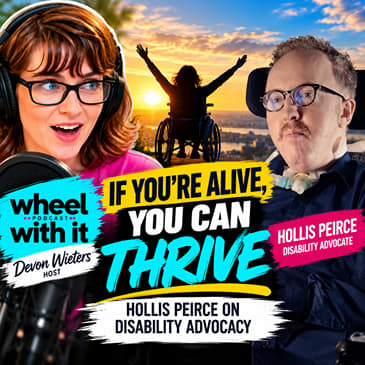
"If you are alive, you can thrive." Hollis Peirce lives by that motto, and in this episode he shows what it looks like in real life.
Hollis is a disability advocate from Ottawa, Ontario, host of the Twenty-First Century Disability podcast, and holds a master's in history from Carleton University. He lives with congenital muscular dystrophy and now uses a ventilator. Devon and Hollis talk about ableism and being spoken down to, founding Ottawa's power wheelchair hockey league, the technology changing disabled lives (like a power chair driven by eye movement), and what living in a complex care unit is really like.
They also compare disability benefits across the border. Hollis explains Ontario's ODSP, the $200 earnings cliff, and the politics behind reform, then wraps up with baseball road trips, Schitt's Creek, and poutine.
Real conversations. Fascinating people. Real hope.
CONNECT WITH HOLLIS PEIRCE
Website: https://www.21stcenturydisability.com/
Instagram: https://www.instagram.com/21stcenturydisability/
Facebook: https://www.facebook.com/21stcenturydisability/
Bluesky: https://bsky.app/profile/21stcentdisability.bsky.social
YouTube: https://www.youtube.com/@21CenturyDisability
LinkedIn: https://www.linkedin.com/in/hollis-peirce-347122239/
CHAPTERS
0:00 Teaser & Intro
0:34 Meet Hollis Peirce
2:04 Ableism & disability advocacy
4:24 The 21st Century Disability podcast & tech
6:02 Living with muscular dystrophy
8:25 Ventilator life & complex care
11:41 ODSP: Ontario's disability benefits
15:04 Benefit reform & Ontario politics
17:49 Visiting America & baseball trips
19:20 Canadian TV and food picks
20:46 Final thoughts & where to follow Hollis
#WheelWithIt #DisabilityAdvocacy #MuscularDystrophy #Ableism #DisabilityPodcast
subscribe by going to wheelwithit.com/subscribe
[00:00:00] I also say at the end of every one of my podcast episodes of 21st Century Disability is that if you are alive, you can thrive. And it really takes that message to heart. No matter who you are, race, color, gender, sexuality, disability, whatever that may be, you can always thrive.
[00:00:27] Stay connected with Wheel With It and Devon Wieters by following us on social media at wheelwithit.com slash follow us. Hello, welcome to another episode of Wheel With It. Today we have Hollis Peirce. I have been talking with him for about 20 minutes before we got started here. And he is awesome. So I'm gonna let him tell you about himself. How are you today, Hollis? Thank you for being here.
[00:00:53] Thank you very much for having me here, Devon. It's a pleasure to be on your podcast. So tell us about yourself and then we will get started. All right. As Devon said, my name is Hollis Peirce. I am from Ottawa, Ontario, Canada. I've been a master's degree in history at Carleton University. And I have dedicated most of my life to outside of the university.
[00:01:23] I have dedicated most of the university. And I've been a master's degree in leadership and my career in history. And I'm a master's degree in education to disability advocacy. And last year I was honored with a governor's award, which is a national Canadian award in terms for my career's work in disability advocacy.
[00:01:41] in other more minor things about me is I'm a huge Edmonton Oilers fan and a massive New York Mets fan. That is amazing. I'm sorry about the Mets. We are on the road to the Bachelor of Glory years. Yes. What exactly do you advocate for in disability advocacy?
[00:02:11] What do you mean by that? What exactly do you push for in your advocacy work? I'm a big advocate in terms of pushing the idea of how ableism is a thing. And I think way too many people, as soon as they, for instance, as soon as they see someone in a wheelchair,
[00:02:36] they automatically think they have a cognitive disability. Yes, can confirm. Yeah, exactly. I have been spoken down to in meetings, in rooms as though I'm a child many times. And also though, I am a disability advocate in terms of just bringing together a disability community as much as I can.
[00:03:03] For instance, I started a power wheelchair hockey league here in Ottawa years ago back in 2009, which is still running. I no longer play in that league. However, I play in another power hockey league, which recently started.
[00:03:24] And yeah, I'm also just an advocate that whatever someone says they can do, they can. And I also say at the end of every one of my podcast episodes of 21st Century Disability is that if you are alive, you can thrive. And I really take that message to heart.
[00:03:55] Even with no matter who you are, race, color, gender, sexuality, disability, whatever that may be, you can always thrive. And thriving in for one person doesn't necessarily mean thriving for another person, if you know what I mean by that. Yes. Yeah.
[00:04:24] So what exactly do you talk about on your podcast? On my podcast, I like to talk about just, I say in the intro of every episode, I say how this is a podcast that is analyzed as how the modern world is changing the way society sees disability. And that is for many reasons.
[00:04:51] Mainly, though, it's because thanks to the 21st Century, there is so many technologies out there that allows for people like you and I, Devin, to overcome a lot of barriers that face us on a day-to-day basis.
[00:05:12] Whether that be a wheelchair that lets us drive around with whatever ways that we can do that. A friend of mine has a power chair that he drives around with his retina. He has an iPad in front of his face and he looks at arrows on the stream and the chair then moves in that direction.
[00:05:40] It's unbelievable. I know. I know. Right? It's amazing. Yeah. And so he doesn't have much physical ability, but he can still move his eyeballs and talk. And so he can still move himself around.
[00:06:02] So how, in that same thing, how has living with muscular dystrophy affected your life personally? Devin, it's affected my life in different ways at different times. Because as a kid, I had much more ability then than I do now. It was fairly similar.
[00:06:29] Like, for instance, I don't have Duchenne's muscular dystrophy. So I've never been able to walk. And I have what's called congenital muscular dystrophy, which is like an umbrella that they put you under if they know you have some form of muscular dystrophy. But they don't know exactly what type you have.
[00:06:56] And so I was never able to walk. I've never been able to push a chair manually. So I received my first power chair when I was about six years old or five years old. And I am perfectly able cognitively. So I've always been in regular classrooms.
[00:07:22] But just with an educational assistant to help me do physical tasks. Such as writing notes or something like that. Yeah. Yeah. And then I still went to university. And I still went to graduate school. And when I was in graduate school, I lived on my own in Carleton's residence.
[00:07:51] Because one of the amazing things about Carleton University is that it has what they call an attendance services program. Where they hire students to work as attendants for fellow students. So I had, when I was living there, I had students helping me get in the shower. Helping me go to the bathroom. Helping me make food.
[00:08:20] Helping me do all that kind of stuff. Yeah. And now, during the pandemic, my disability progressed a bit more. So that to the point where I was no longer able to breathe on my own enough that my body could still get enough oxygen. Or exhale the CO2 that I was producing.
[00:08:50] So as you can see, I've got a vent on me now. And I'm living in a long-term complex care unit. And which has, it's a very laid-backed facility. So it's really just like you're living in your own one-room apartment. Well, I was going to ask you how it was living there and if it felt like a hospital. But I'm glad it doesn't. No, yeah, it does not. Absolutely not.
[00:09:18] So they let you go out and do your thing and stuff and then just come back? Yeah. They, for most people here, they don't let most people, for instance, they don't let most people leave the hospital without somebody that is medically trained. Or able to know how your vent works.
[00:09:44] And in emergency situations, be able to give you your oxygen bag manually until an ambulance gets there. Right? Yeah, that might be a good idea. Yeah, but in a lot of ways, I am a bit more independent than their average patient. Right?
[00:10:07] And if I am able to get out on my own, which I am, I have basically told them that I don't want to be with anybody if I know how to do things on my own. If something happens to me on my own and I'm not with somebody that knows how to handle my care,
[00:10:33] then, and if something major happens to me, like if my vent falls off and I stop breathing and I die, for instance, sorry, I'm not going to soothe them. So I signed a later form. So they let me do, they're a bit more laid back in terms of letting me do what it is that I want to do. That's great. Kind of morbid, the illustration you use, but that's great. Yeah. Definitely.
[00:11:02] Hi, I'm Doug Katz, inventor of the Nulu Kitchen Knife. The Nulu is uniquely shaped to work in harmony with the human body, greatly reducing the strain on muscles and joints common with traditional knives. Not only is the Nulu ergonomic, it's incredibly versatile. This knife is the kitchen MVP.
[00:11:20] Visit us at NuluKnives.com, that's N-U-L-U Knives.com to see this extraordinary knife in action and understand why we say Nulu is the knife that adapts to you. Visit NuluKnives.com and enter code WHEELWITHIT-NULU at checkout. You're on something called ODSP, which is Canada's version of Medicare and Medicaid and Social Security.
[00:11:51] And I thought ours was bad until I heard about yours. But tell us some of the positives and some of the many negatives of that program. Yes, Devin, as you say, I'm on ODSP, which is an acronym for the Ontario Disability Savings Pension.
[00:12:12] And so basically, the only real positive is that they help you pay for the majority of medical needs. They will pay for 75% of your power share every five years. And, but, if you are getting a decent power share, and they're leaving you to pay for 25% of it.
[00:12:42] Yeah, at least my insurance pays for all of it. Dang. Yeah, yeah, they're not, it's really bad. They're not, they don't let you, they don't let you do any kind of, they don't pay for 25% of it, which equates to a couple thousand dollars as well. But you can then apply to other charities to help you out with it,
[00:13:09] such as Muscular Distribute Association, or March Dimes, or something like that. But, generally speaking, I don't tend to do that, just because I think that I'm in a fairly fortunate position, in that my family can help me pay for the other bits of it. And, yeah.
[00:13:38] And, but the negative side of it, which as you, as I was saying to you earlier, there's a lot of it, is that if you earn a little bit more than $200 in a month, they cut you off completely. And they won't pay for anything anymore. That's criminal. Way higher than that. And ours is bad. So, I thought, wow. Okay.
[00:14:07] I don't know who came up with these numbers. The law originally written in 1950 or something? And that's just in Ontario. Because the way health works in Canada is that the majority of healthcare falls under the provincial legislatures. So, like, things like healthcare and education are growing down mainly into provinces,
[00:14:33] or what Americans would think of as states, right? And obviously, the government of Canada does still fund healthcare and education a bit. But that's more major, big things than the provinces, what they are responsible for.
[00:15:02] Well, that's crazy. Do you know if there's any here, we have legislation that's been sitting in Congress for decades to try to reform this stuff. Do you know if there's anything similar over there in Canada? Like what? Like legislation to raise the amount of assets you can have and eliminate any kind of marriage penalty
[00:15:28] and reform how they count assets and all that stuff. Yeah. There is currently, right now, there is a, we're in a provincial election campaign. For instance, in Ontario. Ontario right now is, they have a conservative premier, which is Americans would know as a Republican.
[00:15:54] So they're more conservative against high taxes and that kind of thing. And so right now, there's a, the premier, Doug Fullard, is very anti-Trump and anti-terrorist that are being threatened on Canada from the United States. And so he is, it's very odd, Devin.
[00:16:21] He is, he already has a majority in power. So basically, he already has the majority of seats in the legislature, right? But he is wanting to take advantage right now of his position against Trump and to boost his power even more, right?
[00:16:49] His weakness is that he has very bad healthcare and education policies, like OBSP. But are there enough people in Ontario to make that change? Probably not. So as you say, we're kind of stuck with what we have. Are there any other provinces that are better?
[00:17:20] They're all kind of the same thing. Yeah. No, it's a reality. You gotta live with the reality you have, right? And it's not entirely true. You can also fight. But you can fight, but there's only so much you can do, inevitably. Absolutely. And I hope that one day that will, that there will be a change like that. But who knows? Yeah.
[00:17:50] Have you ever been to America? And if so, how do you like it? Yeah. No, I've been to the United States many times. As a young, as a kid, we used to go to the U.S. quite often every year for our family holidays. And we used to live in Alberta. And back then, we went to places like I was in Seattle one time.
[00:18:17] And I went to a Mariners game and loved it. I am a huge baseball fan. So most of my family vacations ended up with us going to one major city that had a baseball team. And we would go to a baseball game. And then the rest of the trip, we would go to the Atlantic Ocean somewhere.
[00:18:42] Whether it was the Hamptons or somewhere in South Carolina or North Carolina. Yeah. I will now be updating the YouTube and podcast feed every Sunday. Make sure you subscribe for free at either wheelwithit.com slash YouTube or getwheelwithit.com. If you would like updates on the podcast, my advocacy initiatives, and occasional reflections from me,
[00:19:08] subscribe to my Substack newsletter and have it delivered directly to your inbox at wheelwithit.com slash Substack. All Substack articles are written with AI unless otherwise noted. So what is the one exclusively Canadian show that every American must watch? And two, what is the exclusively Canadian food that every American must try? Okay. Okay.
[00:19:37] One exclusively Canadian show that everybody must watch, I would say is Schitt's Creek. Oh, yeah. That's on Netflix here, right? I have to watch that. Yeah, it is. Yeah, it is. That was a CBC show originally. So it was like, or what Americans would call it, PBS. Yes.
[00:20:04] And is it the same version everywhere, or is there an exclusively Canadian version, or does it have Dan Levy in it? No, every version has Dan Levy. Every version has Eugene Levy. And yeah. Okay, so what about the food? I am an Albertan. I am from the West originally, which is why I'm an Oilers fan. So I would say Alberta Beef, but you guys have Alberta Beef there already.
[00:20:34] You just might not know it. But also, I would say, now that I live in the East, I would say poutine. Oh, yeah. One of my mom's friends, she loves poutine. Anything you want to add before we get off here? Yeah, I think you have a great program here, Devin. And you're really having conversations with people that really matter, and you should keep doing it.
[00:21:03] Thank you for the compliment. Always appreciated. These midterm elections are the most important of our lifetime and could decide the future of comprehensive welfare reform and the nation itself. Register to vote. Check your registration to make sure it is up to date. And find your polling place at wheelwithit.com slash vote. Where can people follow you on social media?
[00:21:26] My social media is, my own private one is at cyborg underscore Hollis. And that's on Instagram. And then my Facebook is just me, Hollis Pierce. Pierce with an E-I and not I-E.
[00:21:48] And you can follow my podcast, which is at 21centurydisability on Instagram. And then on Facebook, it's 21stcenturydisability. All letters, 21st is 20 hyphen first. And I am also on Blue Sky, which is cyborg Hollis.bsky.social.
[00:22:18] And 21stcenturydisability.bsky. Okay. And we will have all those links in the show notes. And thank you guys for being here. And we will see you guys next episode. Bye, guys. Thank you for joining us. If you're listening on Spotify or your favorite podcast app, please be sure to hit the follow button. And if available, the bell to get notified when we upload new episodes.
[00:22:47] It really helps support the show. Also, if you're on Spotify, please leave us a comment. If your podcast app allows you to please rate and view us. It helps more people find the show. Remember to follow the show and our guests on social media using the links in the show notes. We'll see you next time.