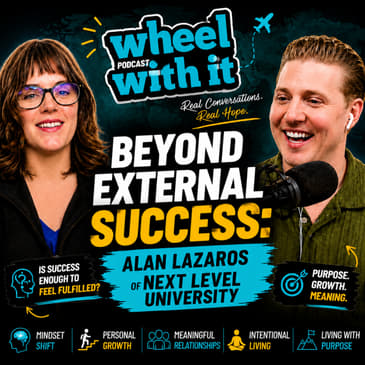
Beyond External Success: Alan Lazaros of @NextLevelUniversity Path to Fulfillment
Alan Lazaros
What happens when external success no longer feels like enough?
In this powerful episode of the Wheel With It Podcast, Devon Wieters sits down with Alan Lazaros of Next Level University to explore the deeper path to fulfillment, purpose, intentional living, and meaningful growth.
Alan shares how chasing achievement alone can still leave people feeling empty — and why true fulfillment comes from alignment, relationships, mindset shifts, and living with intention.
In this episode, we discuss:
• Why external success doesn’t always create happiness
• The difference between achievement and fulfillment
• Purpose-driven living
• Mindset shifts that change your life
• Building meaningful relationships
• Intentional growth and self-awareness
• What it really means to live a fulfilling life
Whether you’re pursuing big goals, searching for meaning, or trying to build a life that truly fulfills you, this conversation is packed with wisdom and practical insight.
🎙️ Guest: Alan Lazaros — Next Level UniversityConnect with Alan:www.facebook.com/ alan.lazaroswww.instagram.com/alazaros88
https://www.linkedin.com/in/alanlazarosilc
Connect with Devon/ the show on social media: wheelwithit.com/followus
subscribe by going to wheelwithit.com/subscribe
[00:00:00] My father passed away in a car accident when he was 28. My trauma response to that was become socially definitely challenges with abandonment type of thing unconsciously. I went from external achievement and external success, but being internally unfulfilled.
[00:00:19] Welcome to the Wheel With It podcast with your host Devon at Wheel With It. No matter who you are or where you come from, there's a place for you. On this show, we have real conversations with fascinating people. Let's get into the episode.
[00:00:31] Hello, hello. Welcome to another episode of Wheel With It. I am your host Devon Wieters and today we have Alan Lazaros. He was fascinating to talk to. He has a great story. I think you guys are really gonna like this one. So here's my conversation.
[00:00:48] Hello, hello. Welcome to another episode of Wheel With It. My name is Devon Wieters and today we have Alan Lazaros on the podcast today. How are you today, Alan?
[00:00:59] I am very well. I want to start with gratitude always. I start and end with gratitude. Thank you for having me. I appreciate it.
[00:01:07] Thank you. Thank you for requesting us.
[00:01:10] You are so very welcome.
[00:01:12] It really needs a lot when people request us. So, have you and your business partner Kevin request us?
[00:01:19] Yeah.
[00:01:19] So, tell us about how.
[00:01:20] You've met Kevin.
[00:01:22] I have not.
[00:01:23] I haven't.
[00:01:23] Coming on after you actually.
[00:01:24] Okay, nice.
[00:01:26] Good, good, good.
[00:01:26] Kevin.
[00:01:28] Kevin Palmieri.
[00:01:29] Yeah, Palmieri.
[00:01:30] Yeah, he's a good guy.
[00:01:31] He's a good guy.
[00:01:32] You'll like him.
[00:01:33] So, to have both of you all do it.
[00:01:35] It's amazing.
[00:01:35] I have you back to back actually.
[00:01:37] So, tell us about yourself and then we'll go from there.
[00:01:40] Okay, so whenever, yeah, tell, I'll tell you where I am now and then I'll go back to the beginning, the origin.
[00:01:47] And we all have a story. I'm going to try to condense 35 years into a very short time here.
[00:01:52] So, now I am the CEO and CFO of a company called Next Level University.
[00:01:57] We are a podcast and a brand, but we also have a company built underneath that.
[00:02:02] We have an 18 person team now.
[00:02:04] We are heard in 175 countries and we're coming up on our 1900th episode.
[00:02:08] So, we've done a lot of episodes.
[00:02:10] We've been podcasting for a long time.
[00:02:12] Incredible.
[00:02:12] Like when I get to 1900, I don't know what I'm going to do.
[00:02:15] Thank you.
[00:02:16] The average length of the show is about a half an hour.
[00:02:18] So, a lot of times when people hear 1900, they figure it's micro content, but it's actually, we do the 1% improvement every day in your pocket from anywhere on the planet completely free.
[00:02:29] Next Level University.
[00:02:30] Level up your life, love, health and wealth.
[00:02:31] So, that's who we are and what we do.
[00:02:33] And the whole goal is to reach, help people reach their potential and be the best version of themselves.
[00:02:37] So, it's Next Level University, but Next Level U, pun intended.
[00:02:41] I always say I'm going to be 36 in November.
[00:02:44] It's actually coming up in 18 days.
[00:02:46] And I'm going to be Allen version 3.6.
[00:02:48] And so, Allen version 3.6 is going to be smarter, stronger, hopefully more virtuous, better than version 3.5, better than version 3.0, better than version 1.5 when I was 15.
[00:02:59] So, the idea is best version of yourself, bettering your best every single day.
[00:03:03] But that's where I am.
[00:03:04] Go ahead.
[00:03:05] That is an amazing way to look at things.
[00:03:07] So, yeah, we should all try to be better every day.
[00:03:11] So, tell us about how you grew up as much as you're comfortable with.
[00:03:15] I know it wasn't easy, but tell us about how you grew up.
[00:03:18] Yeah, started off tough, for sure.
[00:03:22] And definitely had a few beautiful gifts, for sure, too, that I'll be clear about.
[00:03:27] But when I was two years old, my father passed away in a car accident when he was 28.
[00:03:30] So, I had an older sister who was six at the time.
[00:03:34] I was almost three.
[00:03:36] And my mom was 31.
[00:03:38] My birth father's name is John McCorkle.
[00:03:40] So, my real last name is actually McCorkle.
[00:03:42] I had a stepfather from age 3 to 14.
[00:03:44] His name was Steve Lazarus.
[00:03:46] And my last name, I took his last name, I think, around age 6 or 7.
[00:03:53] And my birth father's family, it was Jim, Joe, John, Jane, Joan, Jeanette.
[00:03:58] Six kids, big Irish Catholic family.
[00:04:00] But when we were being Lazaruses, we didn't really associate much with the McCorkles.
[00:04:04] Then my stepfather left when I was 14 years old and took his entire extended family with him.
[00:04:09] I have yet to speak to any of them or see any of them since.
[00:04:13] I did talk to my stepdad a little bit on Facebook Messenger in my mid-20s.
[00:04:17] That year, that same year, my mom got in a fight with my aunt Sandy.
[00:04:22] And we got nauseous sides from that side of the family too.
[00:04:24] And I've seen a couple of my aunt Kathy and then my cousin Jeff from that side.
[00:04:29] And then he has a son named Dan, my second cousin.
[00:04:33] But for the most part, by the time I'm 14 years old, I lost three families in a way.
[00:04:38] Because we didn't really associate with the McCorkles much.
[00:04:40] The Lazarus sort of, Lazaruses went.
[00:04:43] And then my mom's side also went away too.
[00:04:45] And so that was a tough time for sure.
[00:04:47] My sister moved out that same year.
[00:04:49] And so my trauma response to that was become socially definitely challenges with abandonment type of thing unconsciously.
[00:04:55] And then, but I also aim higher, work harder, get smarter.
[00:04:58] It was fight to be better sort of thing.
[00:05:00] And when I looked into the future, there was no generational wealth, no father, no trust fund type of thing.
[00:05:06] And so I really took a lot of responsibility and became the man of the house at 14, so to speak.
[00:05:12] And I did really well in high school.
[00:05:14] I got into my dream college, WPI.
[00:05:16] It's Worcester Polytechnic Institute, kind of like a mini MIT.
[00:05:19] I became a computer engineer.
[00:05:20] I got my master's in business.
[00:05:21] And then I was off to the races in corporate.
[00:05:23] I worked for a bunch of different tech companies.
[00:05:25] I rose very quickly in income and in, I guess, social status is what you'd call it.
[00:05:30] And then I got in my car accident.
[00:05:31] Go ahead.
[00:05:32] Oh, I was going to say to us about the car accident, but you were already going bad.
[00:05:37] Yeah.
[00:05:37] In, I was in New Hampshire with my second cousin, Dan, the one of the very few.
[00:05:43] Yeah.
[00:05:44] Pretty much the only person that's really come back into my life from my mom's side.
[00:05:47] His name is Jeff.
[00:05:48] His son, his name is Dan.
[00:05:49] My second cousin, Dan was in the car with me, but I was at a three-way intersection, dark
[00:05:53] winter night back in 2015.
[00:05:54] The snow banks were covering the yield signs and I was supposed to yield.
[00:05:58] I didn't.
[00:05:59] My fault.
[00:06:00] I ended up on the wrong side of the road.
[00:06:01] And I saw, I looked down at the GPS.
[00:06:03] I look up and I saw the biggest brightest lights I'd ever seen.
[00:06:05] What I thought was a Mack truck.
[00:06:07] Two things saved my life.
[00:06:08] Number one, it wasn't a Mack truck.
[00:06:09] It was a lift kitted pickup truck.
[00:06:11] Fortunately.
[00:06:12] Number two, I was driving a 2004 Volkswagen Passat safest car ever.
[00:06:15] I used to call this car the tank.
[00:06:17] The whole front end was smashed in.
[00:06:18] This was not a fender bender.
[00:06:19] This was a bad car accident.
[00:06:22] Yeah.
[00:06:23] Frame stayed though.
[00:06:24] And the airbags deployed.
[00:06:25] So we were physically okay.
[00:06:27] Fortunately, no permanent damage physically, but mentally, emotionally and spiritually.
[00:06:30] My dad died in a car when he was 28.
[00:06:33] I've seen pictures of his car and this is a second chance my dad never got.
[00:06:38] So after that, I really turned my life around and I went from external achievement and external
[00:06:45] success, but being internally unfulfilled.
[00:06:48] And I flipped the script and I went all the way to deeply fulfilled internally, but I actually
[00:06:54] was not that successful externally at first.
[00:06:56] I pre car accident.
[00:06:58] I had rose really quickly in corporate.
[00:07:00] I paid off all my college debt, 84 grand off in a single year.
[00:07:03] I had a hundred thousand.
[00:07:05] Thank you.
[00:07:05] Thank you.
[00:07:06] Yeah.
[00:07:06] And I had a bunch of investments in Vanguard and stocks and tech companies and stuff.
[00:07:11] And then I liquidated all those assets.
[00:07:13] I went past broke, started my own company called Alan Lazarus LLC.
[00:07:17] What you'll never learn in school, but desperately need to know.
[00:07:20] And I was a speaker, like a motivational speaker, educational speakers, what I called it.
[00:07:25] And then I went broke.
[00:07:26] I was a fitness coach, fitness model, fitness competitor, but I couldn't sustain it.
[00:07:30] So I was internally fulfilled, happy, healthy, productive, but I wasn't externally successful.
[00:07:35] Then eventually I finally got to the place.
[00:07:38] I started a podcast called conversations change lives.
[00:07:41] My business partner, who you mentioned, Kevin started a podcast called the hyperconscious podcast.
[00:07:44] And we teamed up.
[00:07:45] I was his first guest.
[00:07:46] He was my first guest.
[00:07:47] Then we teamed up and then we started what's now known as next level university.
[00:07:51] And now we have an 18 person team and 1900 episodes and we're heard in 175 countries.
[00:07:57] And now we do podcast coaching and business coaching and podcast production.
[00:08:00] And we have a whole company underneath that.
[00:08:01] And we've got book club and meetups and all kinds of stuff.
[00:08:03] But ultimately I went from kid at 14, unsuccessful and unfulfilled to corporate after college, successful
[00:08:13] externally, but unfulfilled internally.
[00:08:15] And then I flipped the script and I went past broke and I was unsuccessful externally, but deeply
[00:08:20] fulfilled internally.
[00:08:21] And then finally in my thirties, I finally created what I think we all want, which is external
[00:08:26] success in tandem with internal fulfillment.
[00:08:29] So that's really cool.
[00:08:31] So tell us about what the journey to starting the business was like, because that was not
[00:08:36] a bit easy if you had literally nothing.
[00:08:39] Yeah.
[00:08:39] So business is the hardest thing in the world.
[00:08:41] One of the hardest things in the world, I should say.
[00:08:43] I think that how did I start the business?
[00:08:45] We have a framework called turn your passion into purpose, into profit.
[00:08:48] And the passion piece is what are you, what do you love?
[00:08:52] What do you adore?
[00:08:53] What do you love doing even when it's hard?
[00:08:55] So for me, weight training, I really have become obsessed with it.
[00:09:00] Podcasting, self-improvement, these kinds of things.
[00:09:02] These are passions.
[00:09:03] But passions without a purpose are empty.
[00:09:05] So how do you turn your passion into purpose?
[00:09:08] Purpose is for others.
[00:09:09] So the podcast is the vehicle, but the purpose is helping other people improve their lives.
[00:09:14] So my passion is improving myself and improve my life.
[00:09:17] And my purpose is to help others do the same.
[00:09:19] And the podcast is vehicle to do that in terms of the profit piece.
[00:09:23] It took us years to figure this out, but the passion, the purpose aren't going to sustain
[00:09:28] themselves unless you learn how to actually make become profitable.
[00:09:31] You, how do you make enough money to sustain it?
[00:09:34] They have a thing.
[00:09:35] So improve your pro your passion for a purpose, helping others, and then make money doing that
[00:09:40] to then reinvest that back into more passion and more purpose and then reinvest and reinvest.
[00:09:47] And so that's what a business is built on is I think in business, you have to be really good at three things.
[00:09:52] The first is metrics and systems and structures and math.
[00:09:56] The second is products and services and innovation.
[00:09:58] You need to have a good product service that you provide to people.
[00:10:02] In this case, this podcast is a service.
[00:10:04] And then the third one is you have to be good with people.
[00:10:07] You, and that's the one that I struggled with.
[00:10:09] I was an engineer, so I wasn't as good with people.
[00:10:12] I struggle with the math part.
[00:10:14] I'm like, I need a like marketing.
[00:10:17] Well, maybe not a marketing person, but I need an accountant to this thing.
[00:10:22] Luckily, my mom is a CFO, so we got that covered.
[00:10:25] Perfect.
[00:10:26] Like, how's the business doing now?
[00:10:28] Do you, what's the podcast about?
[00:10:30] Where can folks check that out?
[00:10:32] Oh, my goodness.
[00:10:34] Thank you.
[00:10:34] Thank you.
[00:10:35] Yes.
[00:10:35] We have a website called next level universe.com.
[00:10:39] All things next level universe.
[00:10:41] Spelt just like it sounds.
[00:10:43] We have a podcast, as I mentioned, called next level university.
[00:10:45] It's a place people go to learn how to reach their potential.
[00:10:48] The slogan is level up yourself, level up your podcast, level up your business type of thing.
[00:10:53] And how is the business doing?
[00:10:56] So this is the most in demand we've ever been.
[00:11:01] Kevin and I are actually quite overwhelmed.
[00:11:02] Today, I've had back to backs and think that the business is doing very well.
[00:11:07] It's doing very well.
[00:11:08] And I'm very grateful because there's two challenges in business.
[00:11:11] There's either not enough demand or too much.
[00:11:14] And I'd much prefer too much than too little.
[00:11:16] So I would, I would like a, I would like a little bit more demand.
[00:11:19] Cause I don't make money off this.
[00:11:21] So if you do have too much to ram, like you can.
[00:11:24] It's a good problem to have.
[00:11:25] It's a really good problem to have.
[00:11:27] However, it also is challenging because how do you sustain it?
[00:11:31] And how do you not only sustain it, but how do you grow it?
[00:11:33] And that's really the challenges.
[00:11:34] The bigger your business gets, that's great.
[00:11:37] And that's wonderful.
[00:11:38] But the more challenging it becomes.
[00:11:40] And I often say the world's biggest lie is that success makes life easier.
[00:11:45] When you get to the NBA, let's say that's your dream.
[00:11:47] Now you have to play against the best players in the world.
[00:11:50] So it actually doesn't make your life easier.
[00:11:52] It makes a lot of times success actually makes it's harder to sustain than I think people think.
[00:11:58] And so every time you level up in life, now there's more responsibility.
[00:12:01] And now there's more skills necessary to succeed.
[00:12:04] And now you have to sustain it and scale it.
[00:12:06] And if you improve yourself, I think, and you focus there, I think when you get to that next level, you'll be ready for it.
[00:12:13] So what would be your advice to somebody that wants to follow their dreams or their passion?
[00:12:21] The first one would be get very clear.
[00:12:24] You have to get really clear on what you're obsessed with.
[00:12:27] And I use obsessed in a positive way, not a negative way.
[00:12:30] So for example, I've always loved film ever since I was a kid.
[00:12:34] When I found self-improvement, I became obsessed.
[00:12:37] I read every book I could get my hands on.
[00:12:40] I listened to audio books constantly.
[00:12:42] I'm always trying to... Fitness is another passion.
[00:12:45] So you don't want to build your dreams around something that is superfluous.
[00:12:49] You don't want to build your dreams around something that's fleeting.
[00:12:52] We all go through phases, right?
[00:12:53] We all grow, change, evolve, adapt.
[00:12:56] There are certain things about you that's never changed.
[00:12:59] There are certain things about you that are never going to change.
[00:13:02] When you find those, that's what you go all in on.
[00:13:07] You don't want to build your career or your business or your dreams on something that's temporary.
[00:13:13] And you really do want to figure out and uncover and get clarity on who am I and what makes me different?
[00:13:22] Where am I the most unique?
[00:13:24] What do I care about deeply enough to build my career and my company on that?
[00:13:29] Where do I, what do I care about deeply enough to build my dreams on that?
[00:13:33] And for example, if you want to be an astronaut, you better be obsessed with space.
[00:13:37] And you better be so obsessed that you're willing to do everything you can to become an astronaut.
[00:13:41] And so I think a lot of people don't achieve their goals.
[00:13:45] And I read the stats on this.
[00:13:47] Actually, we do monthly meetups every month at Next Level University.
[00:13:49] And in January of 2025, we did one called clear goal setting for 2025.
[00:13:59] And we prepped.
[00:14:00] 2024 you mean?
[00:14:02] 2024.
[00:14:02] Thank you.
[00:14:03] Yes.
[00:14:04] In 2024.
[00:14:04] Good call.
[00:14:05] Good call.
[00:14:06] I'm always so future oriented.
[00:14:07] That's my bad.
[00:14:08] Yeah.
[00:14:08] So in January of 2024, we did one setting clear goals for 2024.
[00:14:11] We're probably going to do it again in 2025 actually.
[00:14:13] But I did some research and they, the research that I did showed only 4% of people have written
[00:14:20] goals and only 8% of those people ever achieve them.
[00:14:24] And that statistic alarmed me.
[00:14:26] And I do business coaching, right?
[00:14:28] So it's goals, metrics, habits, skills, and identity work that need to align to achieve
[00:14:32] your goals.
[00:14:33] And so I understand, I understand now why most people don't achieve their goals.
[00:14:37] And the reason why is the goals are predicated on a version of them that isn't real.
[00:14:43] So it's usually predicated on low self-awareness.
[00:14:45] And so if you have high self-awareness, you'll set goals that are actually congruent with
[00:14:49] who you are and who you aspire to be.
[00:14:51] Because we all have who we need to be, who we want to be, and who we actually are.
[00:14:55] And we're all trying to figure out the center point between those three.
[00:14:57] So ultimately, if you want to achieve your dreams and goals, you have to make sure they're
[00:15:01] aligned with who you are and who you aspire to be.
[00:15:04] And you have to be willing to do the work necessary to actually achieve them.
[00:15:08] So that's amazing advice, actually.
[00:15:10] I'm going to go back and listen to that.
[00:15:12] So anything else that you would like to add?
[00:15:15] Where can both take you out?
[00:15:17] Yeah.
[00:15:17] The only thing that I would add is whoever you are, wherever you are, keep after it.
[00:15:22] Stay hopeful.
[00:15:23] Living the dream and chasing the dream are the same thing.
[00:15:27] If you're, I always say this, if you're grinding and growing toward your goals and dreams,
[00:15:32] you are already living the dream.
[00:15:34] The people that are grinding and growing toward their dreams are always going to be the envy
[00:15:38] of the people sitting around feeling sorry for themselves.
[00:15:40] So I'm really encouraging people to dig deep within themselves and take personal responsibility
[00:15:46] for their own life and do all you can with all you have.
[00:15:49] Right.
[00:15:50] And that's the thing.
[00:15:52] But it all starts with personal responsibility.
[00:15:54] And if you can authentically say you're doing all you can with all you have and that you're
[00:15:59] bettering your best and you're getting better and you're improving and you're then your life
[00:16:02] will improve, too.
[00:16:03] And I think I think that's inspiring for all of us.
[00:16:06] That's an amazing way to end it.
[00:16:09] Where can people follow you on social media?
[00:16:12] Okay, so I'm on Instagram.
[00:16:13] I'm on Facebook.
[00:16:14] I'm on LinkedIn.
[00:16:15] I just created a thread account, which is an extension of Instagram.
[00:16:19] I think it's called threads.
[00:16:20] Yes.
[00:16:21] My Instagram is a Lazarus 88, A L A Z A R O S 8 8.
[00:16:26] And my LinkedIn is Alan Lazarus.
[00:16:29] My name, you can Google my name and then type LinkedIn.
[00:16:31] It'll come right up.
[00:16:32] And then my Facebook, I'm Alan Lazarus personal Facebook page.
[00:16:35] You can DM me.
[00:16:36] If you do DM me, please just provide context, obviously, to this episode.
[00:16:41] So I know.
[00:16:41] Yes.
[00:16:42] Don't randomly sign in there.
[00:16:45] Yeah, no, no spam.
[00:16:46] We all get a lot of spam.
[00:16:47] Just please provide context.
[00:16:48] But yeah, I'm on Instagram, Facebook, LinkedIn.
[00:16:50] I also do have a tick tock, but I don't check it often.
[00:16:53] So Instagram, Facebook and LinkedIn are the best places.
[00:16:56] Okay.
[00:16:57] And we hope you guys enjoyed this episode.
[00:16:59] Follow him on social media.
[00:17:02] Tell him, thank you for coming on the show.
[00:17:04] Follow me on social media at we're with a pod and at Devin readers.
[00:17:09] And we'll see you guys next episode.
[00:17:11] Bye guys.
[00:17:12] That was fascinating.
[00:17:13] Wasn't it?
[00:17:14] He was just so sweet and had such a great story.
[00:17:18] I really liked that one.
[00:17:20] So again, follow him on social media.
[00:17:22] Follow me on social media.
[00:17:24] We'll have all those links in the show notes and we will see you guys next episode.
[00:17:28] Bye guys.
[00:17:29] Thank you for joining us.
[00:17:30] We hope you enjoyed the show.
[00:17:32] Remember to follow the show and our guests on social media and subscribe to the show on YouTube
[00:17:36] or in your favorite podcast app using the links in the show notes.
[00:17:40] If you're listening on the podcast app, please remember to rate and review.
[00:17:43] See you next time.